
Am I Ready to Date After a Breakup? What Research Actually Says
No three-month rule. What rebound research shows, when dating helps, when it hides grief, and how to tell the difference.

Key takeaways
- There is no reliable calendar for when you are allowed to date again.
- Rebound relationships are not automatically harmful; motivation matters more than speed.
- Dating to connect and dating to hide grief are different things.
- You can miss your ex and still date carefully, or feel fine and still be avoiding something.
- Honest self-checks beat shame about moving on too fast or too slow.
You are on an app at eleven at night, or you said yes to coffee, or a friend said it is too soon and now you feel guilty on top of everything else.
You still miss your ex. You also want someone to laugh with on a Friday. Those two facts can sit in the same body without one canceling the other. This piece will not tell you a number of weeks to wait. It will not call you broken for wanting closeness, or reckless for swiping. It is here to help you sort out what you actually want from dating right now.
Why There Is No Right Amount of Time
You have probably heard the rules. Half the length of the relationship. Three months minimum. Do not date until you can hear their name without flinching.
Most of those rules are not built from breakup research. They are borrowed, rounded off, or invented, and they tend to make people feel like they are failing when their life does not match.
What research does suggest is messier. Eastwick and colleagues (2008) found that people often overestimate how bad a breakup will feel and how long the distress will last. That does not mean breakups are easy. It means our fear about recovery often runs ahead of the actual experience. For more on timeline myths, getting over a breakup goes deeper.
Sbarra (2006) tracked daily sadness and anger after nonmarital breakups. Recovery was not a single switch flipping on a set date. Acceptance of the ending mattered. So did how preoccupied people still were with the ex. More love, anger, and attachment preoccupation meant sadness took longer to lift. That is about where you are in your head, not a calendar on the wall.
Sbarra and Emery (2005) also showed that love, anger, and sadness after a breakup are separate feelings that move at different speeds. You can have a good week, a decent date, and still get hit by a wave on a random Tuesday. That oscillation is normal. It is not proof you rushed into dating.
Bonanno (2004) found that more people follow a resilient path after loss than pop psychology assumes: hard at first, then a steadier return toward baseline. That does not mean you should pretend you are fine. It means humans are often more adaptable than they credit themselves for.
So if you came here for a permission slip with a date on it, this is not that article. The better question is not “how long” but “why.”

What Rebound Research Actually Shows
“Rebound” gets a bad name. It sounds like a mistake you are not supposed to make.
Brumbaugh and Fraley (2015) looked at people who had started new relationships after a breakup. Those in new relationships reported higher well-being, greater self-esteem, and more resolution over the ex than those who stayed single. Among people who had repartnered, faster repartnering was linked to better psychological health for some participants, not worse.
That is not a command to rush. It is a reason to question the shame. Dating again soon is not automatically self-sabotage.
O’Sullivan, Belu, and Wasson (2025) surveyed young adults ages 18 to 25 who had recently broken up. Those who had entered a new relationship reported fewer intrusive thoughts about the ex than those who stayed single. The stuck feeling was often less about grief itself and more about rumination: the same thoughts looping when you are alone at night.
That study is limited to young adults and does not track whether rebound relationships last. Still, it fits a pattern: for some people, new connection pulls them out of an obsessive loop long enough to function again.
Spielmann, MacDonald, and Wilson (2009) found something similar for anxiously attached people. When they focused on someone new, or even believed a new partner would be easy to find, longing for the ex dropped. For that group, a rebound can be part of letting go, not proof they skipped healing.
Marshall, Di Castro, and Horton (2013) linked anxious attachment to more breakup distress, more tendency to rebound, and in some cases more personal growth afterward. Rebounding was not only avoidance. For some people it was part of moving through the breakup, not around it.
None of this means every quick rebound is wise. It means the moral panic is not fully supported by data either.

When Dating May Be Hiding Grief
The risk is usually not the date on the calendar. It is what the dating is for.
Brumbaugh and Fraley (2015) also found that people in new relationships compared new partners to their ex more often. Comparison is not a crime. It becomes a problem when every person you meet is really a stand-in audition for someone who is gone.
Other patterns worth noticing:
Dating to stop the pain, not to meet someone. If the main draw is relief from missing your ex, the new person is doing a job that grief was supposed to do. That can feel good for a while. It can also leave you stuck when the distraction wears off.
Dating to make your ex jealous or prove you have moved on. You are still organizing your romantic life around them. That is the opposite of ready.
Still hoping for reunion while dating others. Hope is human. It also keeps you in limbo: not fully available to someone new, not fully alone with what you want.
Swiping because silence feels unbearable. After a fresh breakup, quiet can feel like a wall. Wanting company makes sense. Notice whether you want company or anesthesia.
Clinical writing sometimes warns that entering new relationships while old wounds still run the show can repeat old patterns. That is worth taking seriously as a question, not as a verdict. A recent scoping review on rapid repartnering without emotional processing noted links to avoidant coping and unfinished grief for some people. Short-term relief and long-term steadiness are not always the same thing.
The point is not “rebounds never work.” It is: are you dating to connect, or to not feel what you feel about your ex?

Situations the Calendar Ignores
Real life does not sort cleanly into “healed” and “not healed.”
You still hope you might get back together. Dating while part of you waits for reunion often keeps you suspended. Painful, not pathetic. You may need time on your own before you know what you want without them in the picture.
It ended recently and still feels raw. Grief and curiosity can both be true. Low-pressure coffee is not a moral failure. A full relationship plot on date two might be a lot. News about your ex would probably still sting. That is expected this soon.
You still have to stay in touch. Kids, work, a lease. Many people date while coordinating with an ex. It helps to keep logistics practical and romance separate in your head. You do not need zero contact. You do need your ex not to be the main character in every new story.
You are already seeing someone. The question is not whether you waited long enough. It is whether you are being fair to yourself and to them about where your heart still is.
It has been a while and you are exploring. Loneliness and curiosity can look alike from the outside. After each date, ask: did I want to know this person, or did I want to stop being alone?
If you are still deeply entangled with your ex, the Should I do no contact? quiz checks whether you need more distance or tighter boundaries. If you are wondering about friendship instead of dating, the friends with ex quiz looks at a different question.

What Readiness Actually Looks Like
Ready does not mean:
- Never thinking about your ex
- Zero nerves before a first date
- Performing “healed” for someone new
Ready can include:
- Curiosity about the person in front of you, not just relief that someone is paying attention
- Hearing about your ex dating and having a bad hour, not a bad week that rewires every choice
- A sad wave after a good date that passes without meaning you failed
- Still missing someone while choosing not to let that missing steer every swipe
Readiness is a direction, not a finish line. You can be in a steadier place and still have songs that hit wrong.
The Am I ready to date again? quiz asks four honest yes-or-no questions and gives you three possible paths: slow down, go slow, or you might be in a steadier place. It is not a diagnosis. It is a mirror.
How to Decide for Yourself
You do not need a committee. A few plain checks tend to help:
After a date, ask what you wanted. Company, or distraction? There is no wrong answer. You just want to know the truth.
Notice who you are swiping for. Someone new, or a version of your ex with a different face?
Track what happens when you hear ex news. A sting is normal. Days of spiraling is information.
Pay attention to comparison. Everyone gets compared a little at first. If nobody clears the bar because the bar is still your ex, that is worth noting.
Write it down once. What do you actually want from dating right now? Not what would look good to friends. Not what would prove something to your ex. What you want.

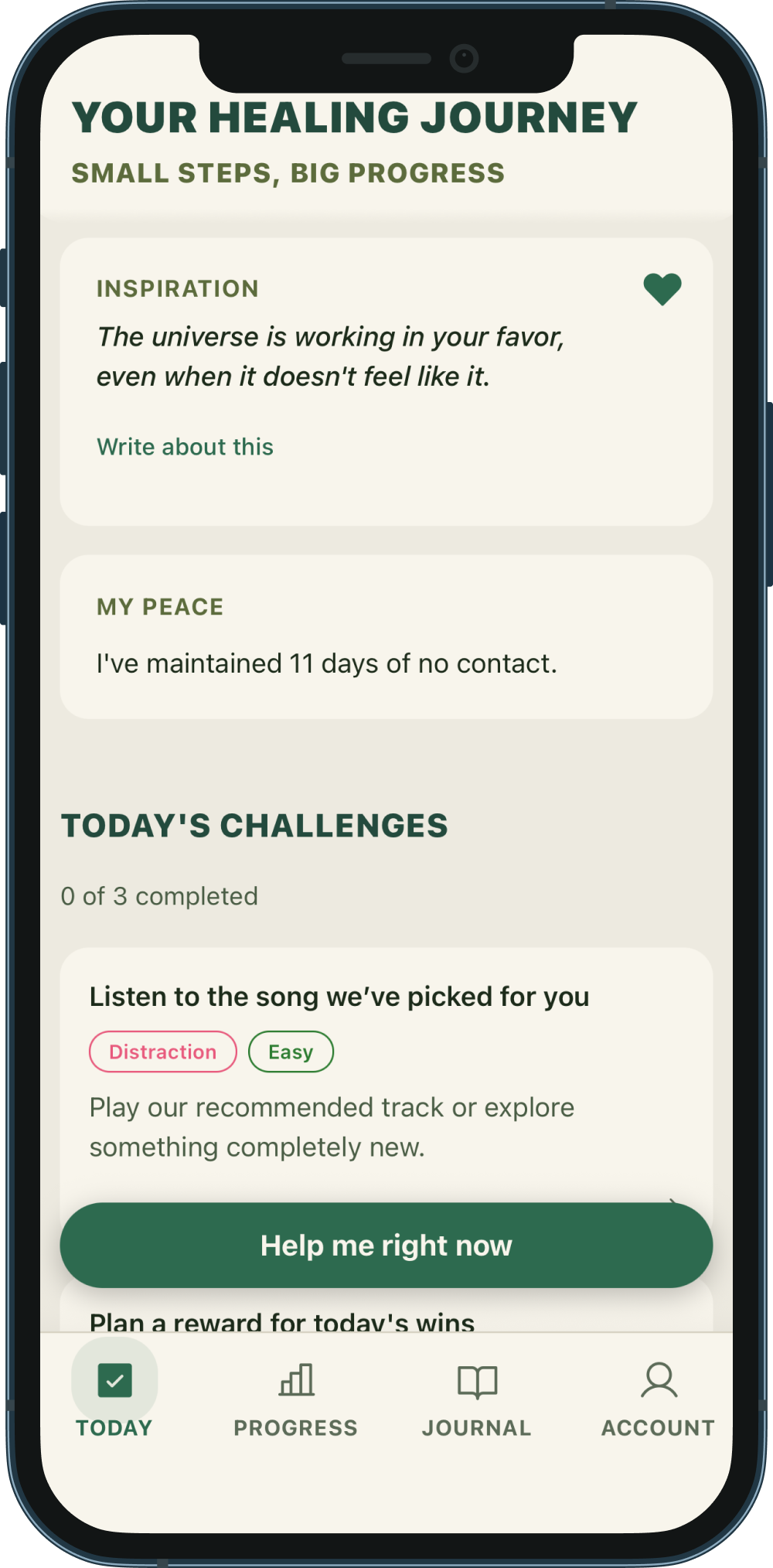
If you want a private place to check in after dates without turning it into a performance, Breakup Reset has journaling and short check-ins. One honest sentence after coffee can be enough.
Breakup Reset
Free support for the week ahead
- Completely free
- Three challenges a day
- At your own pace
When This Is Not the Right Question
If you do not feel safe around your ex, dating readiness is not the issue. Get support from someone you trust or a professional.
If you cannot function for weeks (sleep, food, work, basic tasks), that is worth more than a quiz. When you cannot function after a breakup covers when grief may need more help than time alone.
If you still love them deeply and the ending was right but the feeling has not moved, getting over someone you still love speaks to that specific ache.
Missing your ex and opening up to someone new can coexist. The work is telling the difference between connection and escape, and being honest when you are not sure yet.
You do not owe anyone a timeline. You owe yourself the truth about what you are looking for.
If friendship is the real question, see can you be friends with your ex. If they moved on first and you feel stuck, when your ex moves on first speaks to that shock.
Brumbaugh, C. C., & Fraley, R. C. (2015). Too fast, too soon? An empirical investigation into rebound relationships. Journal of Social and Personal Relationships, 32(1), 99–118. / O’Sullivan, L. F., Belu, C. F., & Wasson, K. S. (2025). Breaking up and bouncing back: Distress and post-breakup adjustment of young adults. Archives of Sexual Behavior, 54(9), 3405–3421. / Spielmann, S. S., MacDonald, G., & Wilson, A. E. (2009). On the rebound: Focusing on someone new helps anxiously attached individuals let go of ex-partners. Personality and Social Psychology Bulletin, 35(10), 1382–1394. / Sbarra, D. A. (2006). Predicting the onset of emotional recovery following nonmarital relationship dissolution. Personality and Social Psychology Bulletin, 32(2), 298–306. / Marshall, T. C., Di Castro, P., & Horton, A. L. (2013). Attachment styles and personal growth following romantic breakups. PLOS ONE, 8(9), e75161. / Eastwick, P. W., Finkel, E. J., Krishnamurti, T., & Loewenstein, G. (2008). Mispredicting distress following romantic breakup. Journal of Experimental Social Psychology, 44(3), 800–807.
Frequently Asked Questions
Is there a right amount of time to wait before dating again?
No single number works for everyone. Research on breakup recovery points more to acceptance, attachment, and rumination than to weeks on a calendar. Some people need a long pause. Some feel okay sooner. What matters more is why you want to date.
Are rebound relationships always bad?
No. Studies by Brumbaugh and Fraley (2015) and O'Sullivan and colleagues (2025) find that dating again can be linked to better adjustment for some people. The risk rises when a new relationship is mainly a way to avoid grief, not when someone is genuinely curious about someone new.
Can I date if I still miss my ex?
Missing someone does not automatically mean stop. It means paying attention to whether missing them is still steering your choices: who you swipe on, what you compare, whether you are hoping to be seen.
What if I still hope we get back together?
That hope is human. Dating while holding onto it often keeps you suspended. You can want them back and still choose to pause dating until you know what you want on your own.
Can I date while co-parenting or staying in touch with my ex?
Yes. Many people do. It helps to keep logistics separate from romance, and to be upfront with new partners when the time is right. You do not need your ex fully out of your life. You do need them not to be the main story in your head.
I am already seeing someone. Is it too late to ask?
The fair question is whether you are being honest with yourself and with them about how much of your heart is still elsewhere. That is worth asking at any stage.
What if hearing my ex is dating wrecked me?
That can hurt even when you are doing well. One bad day does not erase progress. If it wrecks you for days and changes every decision, that is worth noticing.
I do not feel safe around my ex. Is this the right question?
No. If you do not feel safe, focus on support from people you trust or a professional. This article is for the messy middle, not danger.