
Getting Over Someone You Still Love: When the Breakup Was Right but the Feelings Are Not Gone
Moving on when you still love your ex is one of the hardest situations to find good advice for. Here is what actually helps when the feelings did not get the memo.

Key takeaways
- Love and relationship status are separate systems: the relationship can end while the attachment persists for some time.
- The attachment circuitry does not switch off at the moment of breakup; it deactivates over time, inconsistently.
- Much breakup advice relies on anger to create distance, this article is for when there is none.
- Closure built from the inside is more durable than closure waited on from them.
- Still loving someone is not a reason to stay; it is a measure of what the connection meant.
You know why it ended, or it ended for you, and you still miss them. The feeling did not get the memo. You are not confused about whether it was right. You just also still love them, and most of what people say about breakups assumes you will eventually stop.
Most advice about moving on from a relationship carries an implicit assumption: that at some point you will see more clearly, or decide they were not right for you, or arrive at enough distance to convert the love into something cooler. That framing does not fit everyone. It does not fit people who loved clearly, who left or were left without a dramatic unmasking, who understand what happened and still carry the feeling.
This article is for that specific situation.
Why Love Does Not Stop When a Relationship Ends
Love and relationship status are not the same thing. One is a status, together or not. The other is a neurological and psychological state that took time to develop and takes time to reorganize.
Fisher et al. (2010) studied brain activity in people recently rejected in love and found that the reward and craving circuitry associated with romantic love remains activated after a relationship ends. It does not switch off at the point of the breakup. It deactivates over time, inconsistently, and often reactivates in response to reminders. The love you are feeling is real, and it is not a sign the relationship should have continued. It is a sign the attachment was real.
The attachment was not a choice. It formed over time through repeated experience with a particular person. The ending of the relationship is an event; the reorganization takes much longer than the event.
This is also why contact during this period tends to prolong the love rather than resolve it. Every interaction reactivates the circuitry. The reorganization can only happen in the absence of the activation.
The Absence of Anger
A lot of breakup advice, the frameworks about no contact, reclaiming your identity, recognizing your worth, is built, implicitly, around some anger. Anger is useful for distance. It provides a reason to stay away, a framework for self-protection, a narrative about what you deserve.
When there is no anger, when the ending was reasonably handled, or was mutual in all but the official decision, or was about incompatibility rather than cruelty, that advice can feel hollow. “Recognize your worth” lands differently when you do not feel diminished. “They did not deserve you” lands differently when you actually think they are a good person.
Name this plainly. You may not be angry. That is not a failure of your recovery process. It changes what helps.
Without anger, the work is not about protecting yourself from someone bad for you. It is about making space for the feeling to slow down without needing contempt to do it. Slower. Less dramatic. You are building your own closure rather than using resentment as the exit ramp.
What Closure Actually Requires Here
Waiting for them to give you closure is usually waiting for something that will not arrive in the form you need it.
The closure you imagine, the conversation that fully accounts for the ending, the explanation that makes the feelings make sense, the acknowledgment that validates what you went through, is rarely delivered with enough precision to genuinely settle what the mind is asking. Even people who try to give it usually cannot. The question you need answered is not really one they can answer.
Self-closure means building your own version. Write what you know for certain:
What the relationship gave you. What you showed up for. What you put in, honestly, without editing it for how it looks. What you learned about yourself from being with them. What it cost you and what it taught you.
This is not about dismissing the love, or rewriting them as worse than they were, or persuading yourself the ending was the right call. It is about constructing an account of what happened that is yours, that does not require their participation to stand.

Slotter, Gardner and Finkel (2010) found that self-concept clarity, a stable, clear sense of who you are, predicts recovery from breakup distress. Deeply loving relationships tend to lower that clarity after ending, because more of the self was built in relation to the other person. Part of this work is identity work: who am I in this, what do I know about myself now, who am I without that shared context.
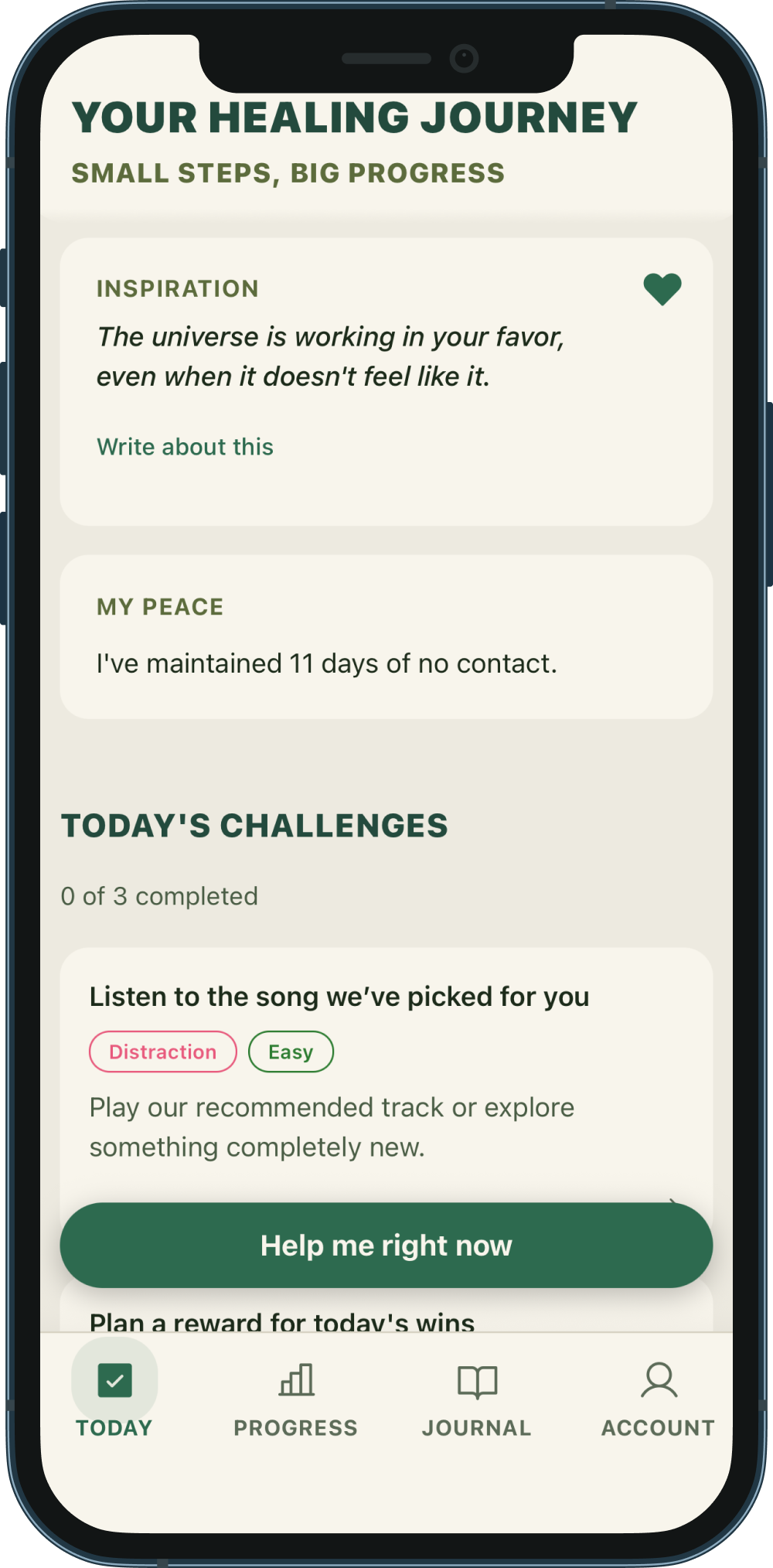
Breakup Reset builds challenges around the recovery pattern that most often shows up when you still love them. The self-care challenges address the urge to reach out and self-soothe; the discovery challenges turn attention toward you, who you are independently, what the relationship showed you about yourself. Both categories matter more than distraction here.
Breakup Reset
Free support for the week ahead
- Completely free
- Three challenges a day
- At your own pace
The Self-Blame Loop
When you are still carrying love for someone who is not in your life, the mind sometimes turns the ending into a verdict: that you were not enough, not right, not lovable. That if you had been different the outcome would have been different. That the fact that they could leave means something permanent about your worth.
Break this down honestly. A relationship ending is a compatibility outcome, sometimes also a timing outcome, sometimes a choice one person made that the other did not want. It is not a verdict on your worth.
Your care in the relationship was real. The love was real. The effort was real. Those things do not disappear because the relationship ended, and they are not cancelled by the ending. Self-validation, naming what you gave, what you showed up for, is not denial. It is accuracy.
What Helps When the Love Is Still There
Distance from contact, framed honestly. No contact is useful here, but not because they were bad for you. It is because contact while you still love them keeps the attachment circuitry activated, which prevents the slow reorganization the system needs. Distance is not punishment or protection. It is the condition for the change to happen.
Journal to the future version of yourself. Not to them. Not about them. To the person you will be in a year or two who has moved through this. Write what you want them to know. What was real. What it meant. What you did not want to lose.
Honesty over toxic positivity. “I can carry this and still move through it” is more useful than “I will be fine.” You may be fine. You also may not be fine yet, and that is allowed. Honest framing lands better than hollow reassurance.
For more on the practical mechanics of keeping distance when you still love them, should you do no contact covers the reasoning and the exceptions.
Both Things Can Be True at Once
Still loving someone who is not in your life anymore is not a failing. It is a measure of what the connection meant. The question is not how to stop loving them. It is how to let the feeling coexist with moving forward, which takes time and does not require you to resolve the love first.
You do not have to decide not to love them. The reorganization happens on its own terms, over time, mostly in their absence. What you can do is stop feeding the loop: stop seeking contact that reactivates the craving, build your own account of what happened, and let the feelings exist without requiring them to be over yet.
They will be, eventually. Not as a decision, but as a process.
Fisher, H.E., Brown, L.L., Aron, A., Strong, G. & Mashek, D. (2010). Reward, addiction, and emotion regulation systems associated with rejection in love. Journal of Neurophysiology, 104(1), 51–60. / Sbarra, D.A. (2006). Predicting the onset of emotional recovery following nonmarital relationship dissolution: Survival analyses of sadness and anger. Personality and Social Psychology Bulletin, 32(3), 298–312. / Slotter, E.B., Gardner, W.L. & Finkel, E.J. (2010). Who am I without you? The influence of romantic breakup on the self-concept. Personality and Social Psychology Bulletin, 36(2), 147–160.
Frequently Asked Questions
How do you move on from someone you still love?
Slowly, and not by deciding to stop loving them. The attachment reorganizes over time, not by choice. What helps is creating the conditions for that reorganization: distance from contact (which keeps the attachment activated), small rebuilding of your own life structure, and closure that you build from the inside rather than waiting for them to give it to you. It takes longer when you still love them, and that is not a failure.
Why is there no anger when I still love my ex, and does that make it harder?
A lot of breakup advice, no contact, reclaiming yourself, recognizing your worth, is implicitly built around some anger or resentment to fuel distance. When there is no anger, that advice can feel inapplicable or hollow. It does not make your situation harder in the sense of being worse, but it does mean some common approaches do not fit. Grief without anger needs different strategies: not building distance out of hostility, but creating space for reorganization without contempt.
What does self-closure mean in practice?
Self-closure means constructing your own account of what happened and what it meant, without depending on their version. Write what you know for certain: what the relationship gave you, what you showed up for, what it taught you about what you need. This is not a way to dismiss the love. It is a way to honor it without keeping it dependent on them. It is slower and less satisfying than the closure you want from them, but it is more durable.