
Can You Be Friends with Your Ex? What Actually Determines It
Sometimes post-breakup friendship works. More often it does not, at least not yet. Here is what actually determines whether staying friends will help or hurt you.

Key takeaways
- Post-breakup friendship works when the romantic attachment has actually faded, not just quieted down.
- Wanting friendship is often wanting closeness, not wanting a platonic connection.
- Staying friends while you still have feelings keeps the wound open. It is not noble. It is usually just painful.
- The clearest signs you are not ready: your pulse spikes at their name, you are hoping something shifts, news of them dating hurts.
- Friendship is more likely to work when it is not standing in for grief.
You want to stay in their life. That is honest. What is worth asking is what part of their life you actually want.
A platonic friend who texts occasionally, shows up to group events, maybe grabs coffee twice a year? Or the version of them that was close to you, knew your history, was the person you called when something happened?
Those are different things. The second one does not exist anymore, not in the same form. What people often want when they say they want friendship is that closeness, not a new connection built from scratch. That is where the question actually starts.

Why People Want to Stay Friends
Shared history. You spent time building something. It feels like a waste to lose it entirely. That feeling is real. It is also not a good enough reason on its own.
Fear of full loss. Losing the relationship is one thing. Losing the person entirely is another. Keeping a friendship open can feel like softening that second loss. It can also stop both of you from moving through the first one.
Hope dressed as friendship. This one is harder to see from the inside. Staying friends can be how you keep the door open without having to say so. Some part of you believes proximity might change things, that they will see you differently, that closeness will bring them back. Friendship used this way does not function like friendship. It functions like waiting.
Genuine care that did not disappear. Sometimes people do care about each other without wanting to be together. That kind of friendship is possible. It tends to emerge after a real gap, not immediately after the end.
When It Can Work
Research on post-dissolution friendship (Tan, Arriaga & Agnew, 2023) found that these friendships held up better when the relationship ended on relatively equal terms, when neither person was significantly more attached than the other, and when the friendship was not filling the same role the relationship had.
That last part matters most. Friendship that picks up where the relationship left off emotionally is not friendship. It is a substitute, and it tends to keep both people stuck.
Friendship after a breakup is more likely to work when:
Neither person is still attached. Not just behaving as if they are not, but actually not. The pull has gone on both sides. Contact does not stir longing or hope.
There is no quiet hope underneath. Neither person is expecting the friendship to become something more. Both are genuinely fine with the other dating, moving away, building a life that does not involve them.
There has been enough time. Not a fixed number of weeks. Enough for the attachment to actually settle, not just for both of you to get good at acting calm around each other.
You like each other as people. You want to know how they are doing without needing the answer to mean anything.
When It Usually Does Not Work
Too soon. The attachment is still active. You have not had space to grieve. Being friends means performing a closeness that is either false or too real, and neither is comfortable for long.
Asymmetric feelings. One person has moved on. The other has not. Friendship in that situation usually costs the person who is still attached more than it gives them.
Contact makes things worse. If you feel worse for a day after seeing them, that is a signal. Not a verdict on you, just your body still reacting. Friendship works better once contact registers as neutral.
You are hoping it turns into something else. If part of you is watching for signs they want you back, friendship is not actually what you are doing. You are auditing the relationship for chances of reopening it.
Breakup Reset
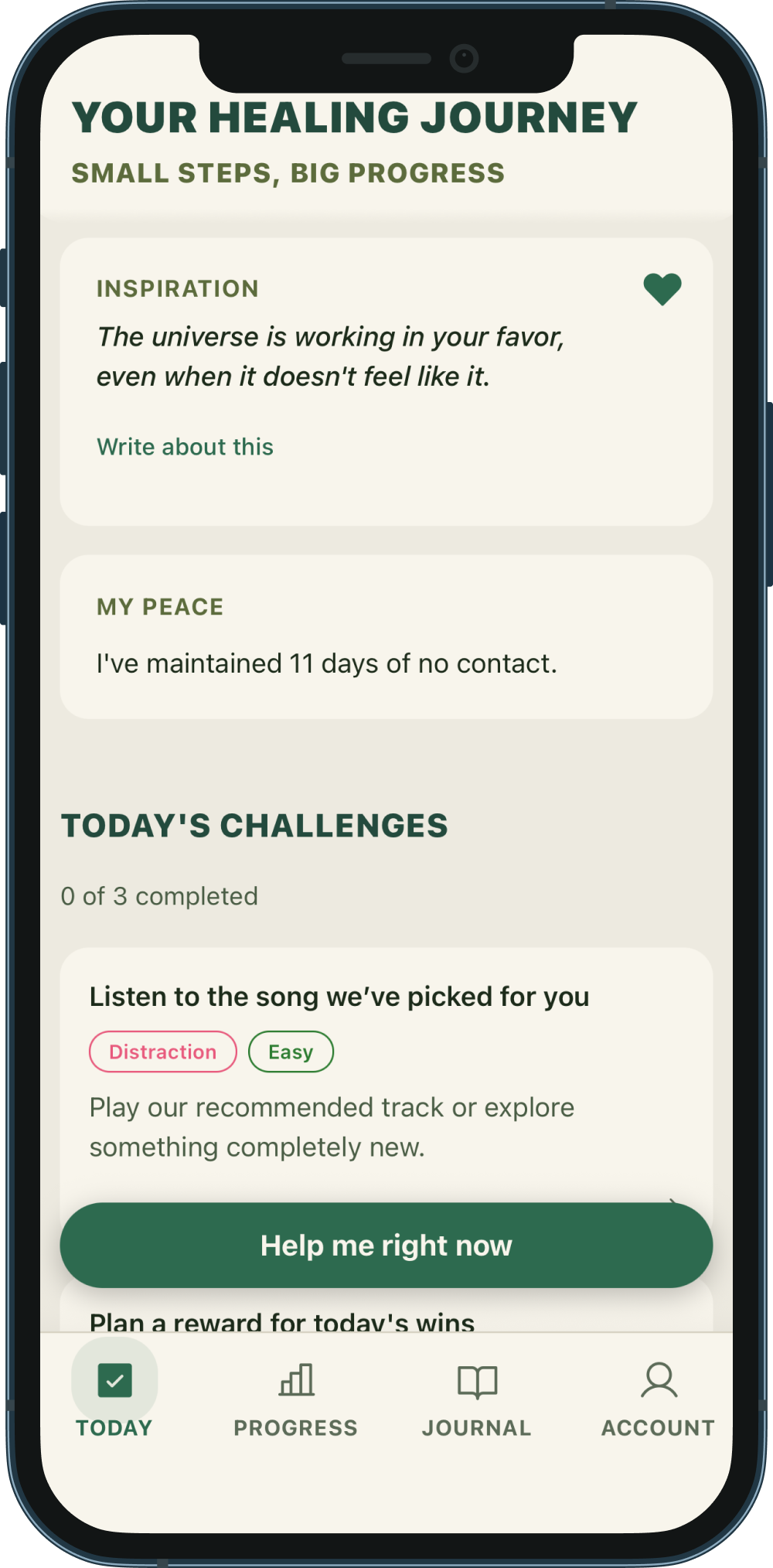
Free support for the week ahead
- Completely free
- Three challenges a day
- At your own pace
The Trap of Staying Close to Avoid Grief
Grief after a breakup is uncomfortable. Staying in contact, even light contact, can mute it. You are not fully in the relationship, but you are not fully out either. You get small doses of closeness that take the edge off the loss without moving through it.

Grief needs space. Contact that keeps muting it also keeps extending it. People who stay in loose post-breakup contact often find recovery takes longer, not because they are weaker, but because they keep giving themselves reasons not to process the loss.
Tan et al. (2023) note that post-dissolution friendships are most stable when they do not fill the emotional role the relationship played. When friendship is filling that role, it is not friendship that is being maintained. It is the attachment, in a different shape.
That is not an argument against friendship permanently. It is an argument for being honest about what the friendship is doing for you right now.
Signs You Are Probably Not Ready
Any one of these is enough. You do not need all of them.
Your pulse changes when you see their name. Not mild surprise. A spike, a drop, a tightening in your chest.
You are hoping proximity will change things. Some part of you believes staying in their life might eventually shift their mind. That part has not accepted the ending.
News about them dating would hurt. Not mildly. Actually. If imagining them happy with someone else causes a real emotional reaction, the attachment is still there.
You are still waiting for a full accounting. You want them to understand what they did, or acknowledge what you gave, or explain the ending in a way that finally makes sense. That usually means the attachment is not finished, not that you lack clarity.
If any of those land, take the Am I ready to be friends with my ex? quiz. It checks them directly in four questions.
Signs You Might Actually Be Ready
Contact feels neutral. Seeing their name or hearing from them does not register much in either direction.
You are not waiting for anything. No apology, no explanation, no sign they want you back. The ending is the ending, and that is settled.
Their future is genuinely theirs. If they told you tomorrow they were in a new relationship and happy, you would feel mostly fine with that.
You want friendship for what it is. Not to stay close, not to keep options open, but because you actually like them and want to know how they are doing.
If you are not sure which side you are on, the free quiz can help you tell.
If You Decide to Try It
Start with something small. A catch-up message, not a plan to rebuild everything at once. See how you feel before and after. If you feel fine, that is good information. If you feel worse, that tells you something too.
Keep it clearly limited. Friendship with an ex is not the same closeness you had. You are building something different, not picking up where you left off.
If contact stirs hope, longing, or resentment, you do not have to push through it. You are allowed to decide the timing is wrong and come back to it later.
For thinking through the distance question first, should you do no contact is worth reading. If the loop of thinking about them is still loud, how to cope with a breakup when you cannot stop thinking about them covers what tends to quiet it. If dating is the real question instead of friendship, see am I ready to date after a breakup.
Tan, K., Arriaga, X.B. & Agnew, C.R. (2023). More than friends? Predictors and relational outcomes of maintaining post-dissolution friendships. Personal Relationships. / Sbarra, D.A. & Hazan, C. (2008). Coregulation, dysregulation, self-regulation: An integrative analysis and empirical agenda for understanding adult attachment, separation, loss, and recovery. Perspectives on Psychological Science, 3(2), 141–167.
Frequently Asked Questions
Can you be friends with your ex?
Sometimes, but timing matters more than intention. Friendship after a breakup tends to work when the romantic attachment has genuinely faded on both sides, when neither person is using it to stay close out of hope or habit, and when contact does not consistently leave one or both people worse off. Those conditions take time. How much depends on the relationship, not a fixed number of weeks.
How long should you wait before trying to be friends with your ex?
There is no reliable number. The relevant question is whether you can hear about them dating someone new without a meaningful emotional reaction, whether you have stopped hoping friendship leads somewhere else, and whether you are not bracing for apologies or explanations. Those are the checkpoints, not a calendar. Some people reach them in months. Others take longer. Some do not get there at all, and that is valid too.
What are the signs you are not ready to be friends with your ex?
Your heart rate spikes when you see their name. You are hoping staying in their life will change their mind. News about them dating someone new causes real pain. You are still waiting for an apology or explanation that would make the ending feel fair. Any of those suggests the attachment is still active enough that friendship is more likely to keep the wound open than close it.