
Anxious Attachment after a Breakup: Why You Can't Stop Reaching for Them
Anxious attachment can make breakup grief feel louder and longer. Here is what drives the reaching, the replaying, and the urge for closure, and what actually helps.
Key takeaways
- Anxious attachment is a learned vigilance pattern, not a disorder, and not a sign you loved them more.
- When you lose someone your nervous system had learned to co-regulate with, the loss is partly physical, not just emotional.
- The urge to reach out is the attachment system seeking safety. Real as a feeling, not necessarily true as a command.
- Rumination feels like solving something; it usually keeps the loop running rather than resolving it.
- Self-closure can be built from the inside: writing your own account, without waiting for their version.
You have checked their profile three times today and told yourself each time you would not. You are replaying a conversation from a month ago, looking for the exact moment it shifted. The urge to send one more message, to get one more answer, to find out whether there is any chance. It does not feel like a choice. It feels like a need.
This is not because you loved them more than most people love. It is because of how your nervous system learned to handle closeness, and what happens when that closeness disappears.
What Anxious Attachment Actually Is
Attachment patterns are learned. They develop early, through repeated experiences of whether closeness was reliable or uncertain, whether reaching out brought you safety or unpredictability. The mind gets good at whichever response those early experiences taught it.
Anxious attachment, broadly, is the pattern of staying alert for signs that closeness might be withdrawn. Hazan and Shaver (1987) described how adult romantic relationships draw on the same attachment system that forms in infancy. When that system learned that connection is uncertain, it keeps watching, reading tone, tracking distance, bracing for loss.
This is not pathology. It is adaptation. A lot of people have this pattern to some degree, and it can coexist with successful relationships. The watch does not run constantly; it gets louder under threat.
A breakup is about the loudest signal of threat the attachment system knows.
Why Breakups Hit Differently with This Pattern
When you are in a close relationship, particularly a long one, your nervous system learns to co-regulate with the other person’s presence. Their voice, their physical presence, even knowing they are available, these have a calming effect that becomes built in over time. Sbarra and Hazan (2008) describe the physiological dimension of this: the loss of a close relationship is not only emotional. It disrupts a regulatory system the body had been relying on.
For people with an anxious attachment pattern, this disruption is more acute. The nervous system was already primed to monitor for distance. When the relationship ends, that monitoring system has nothing left to track, and it does not simply switch off. It casts for signals. It checks. It looks for any evidence that safety might be recoverable.
This is why the checking feels compulsive rather than chosen. It is not a decision your mind made. It is a system doing what it was designed to do.
There is also the closure problem. Anxious attachment tends to produce a stronger need for a clear ending, proof it is over, or proof it is not, or at least a reason that accounts for everything. Ambiguous endings without clear explanation feed this more than clean ones, because the mind keeps working on open questions.
What the Reaching-Out Urge Actually Is
The urge is the body reaching toward what it learned meant safety. It has identified a threat (the loss of the relationship) and is running the response it learned for that situation: reach toward closeness. The feeling is real. The interpretation, I need to contact them, is a story the mind puts around the feeling.
Davis, Shaver and Vernon (2003) found that people with anxious attachment styles show more intense behavioral reactions to breakups, including more contact-seeking. The pattern is not unusual. It is also not a verdict on the relationship. It is a response to disruption, not evidence that reaching out is the right move.
Acting on the urge does not resolve it. A reply, a conversation, a moment of warmth, these briefly soothe and then the loop resets, often stronger. The craving does not get met; it gets briefly fed, which is different.
What can help in the moment is naming the urge rather than obeying it. This is the wave, not the verdict. You do not have to argue yourself out of feeling it. You only have to not send the message in the next fifteen minutes.

The Rumination Loop and How to Interrupt It
Replaying conversations, rerunning the ending, searching for the moment it went wrong, this feels like work. Like if you go over it enough times you will find the answer that makes it make sense, or find proof that there is still a chance, or figure out what you could have done differently.
Nolen-Hoeksema (1991) found that repetitive processing tends to maintain distress rather than resolve it, originally studied in depression, but the pattern holds across grief and loss. The loop feels productive. It usually is not.
Brief, intentional reflection is different from involuntary looping. Choosing a timed journal session is different from the mind pulling you back in when you are trying to do something else.
Interrupting the loop does not require willpower to stop thinking. It requires redirecting to something concrete enough to occupy a different part of the mind. A short walk, a physical task, a ten-minute call with someone who is not analyzing the breakup with you, long enough for the wave to lose some volume.
What Self-Closure Looks Like
Closure is real. The mistake is waiting for it to arrive from the other person.
What you are waiting for, the explanation that fully accounts for the ending, the acknowledgment of your experience, the reassurance that you were enough, is rarely delivered in the form you need it. Even people who do provide it often cannot give it with enough specificity to truly settle the question the mind is asking.
Self-closure means constructing your own version. Not a rewrite of the relationship, not a defense of yourself, but an honest account: what happened, what you knew, what you gave, what it meant.
Write what you are certain of. What the relationship gave you. What you showed up for. What it cost you and what it taught you. This is not about persuading yourself the ending was right, or that they were wrong. It is about building a version of events that is yours: one that does not require their participation to be stable.
Self-validation matters in this too. Your care in the relationship was real. Your effort was real. That does not disappear because the relationship ended.
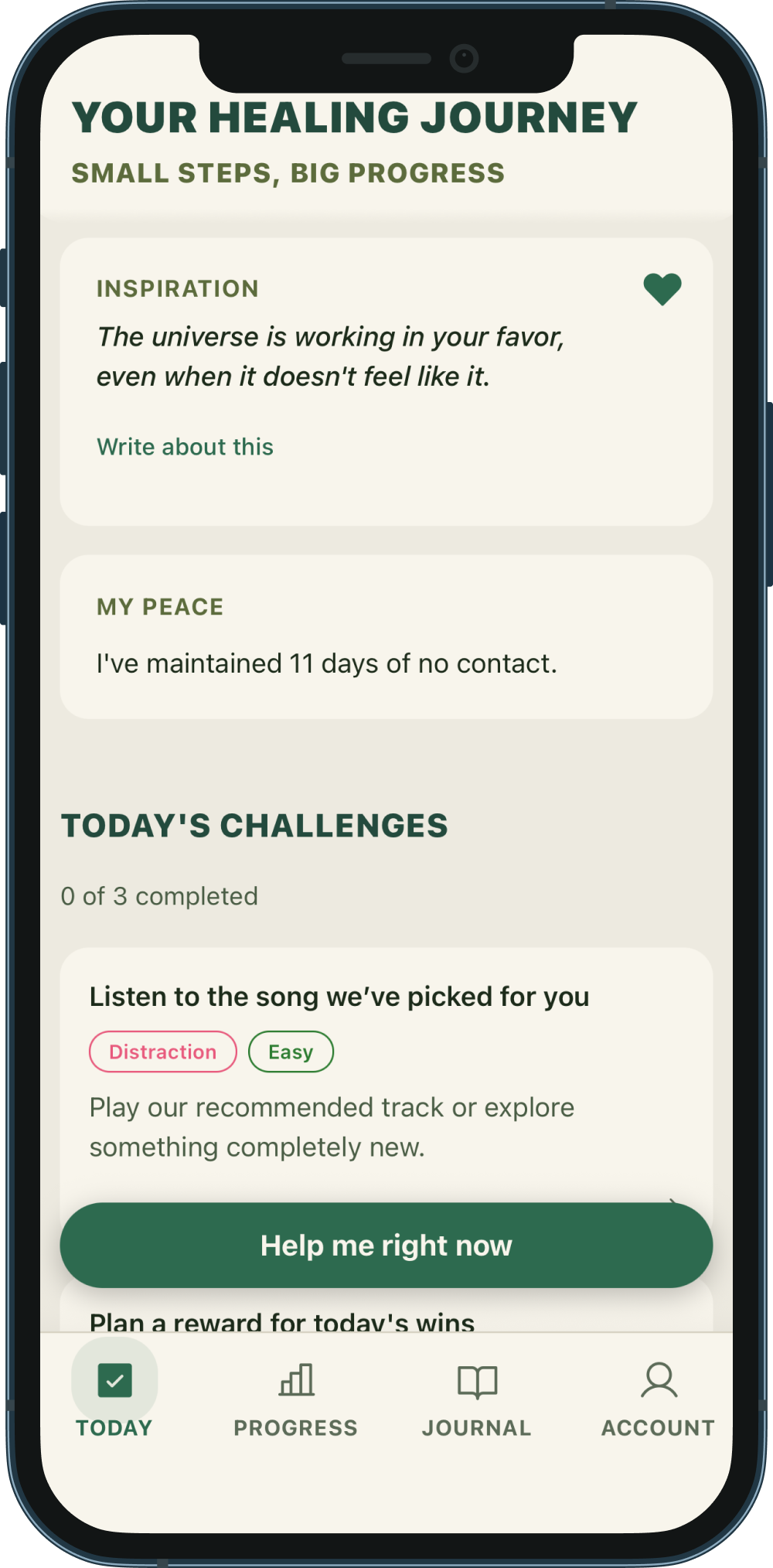
If this pattern sounds like yours, Breakup Reset calls it the Reconnector type. The self-care challenges address the urge to reach out and the reassurance loop; the discovery challenges turn attention toward you, who you are independently, what the relationship showed you about yourself. The journal is where the self-closure writing lives.
Breakup Reset
Free support for the week ahead
- Completely free
- Three challenges a day
- At your own pace
The Pattern Shifts
Anxious attachment is one of the most studied patterns in relationship research. It is also one of the most workable. The nervous system learned it; the nervous system can learn something different, over time, through different experiences.
That is not a quick process, and this article is not about fixing your attachment style. It is about understanding that the compulsive checking, the replaying, the urge that feels like fact: these are a trained pattern responding to loss. They are not a verdict on you, or on what you deserve, or on how the relationship should have ended.
The pull to reach out will ease. Not by willpower, but by not feeding the loop when it activates. The rumination will quiet. The closure you are waiting for will not come from them the way you imagine, but it can be built. That work starts from the inside.
For more on why the replaying loop feels so real, how to cope with a breakup when you cannot stop thinking about them goes deeper into that pattern. If your grief looks more like shutdown than reaching, see avoidant attachment after a breakup. For the question of whether to reach out at all, no contact after a breakup is worth reading before you decide. If you are wondering whether friendship is realistic yet, the Am I ready to be friends with my ex? quiz can help you see whether you are still attached or actually ready.
Hazan, C. & Shaver, P.R. (1987). Romantic love conceptualized as an attachment process. Journal of Personality and Social Psychology, 52(3), 511–524. / Sbarra, D.A. & Hazan, C. (2008). Coregulation, dysregulation, self-regulation: An integrative analysis and empirical agenda for understanding adult attachment, separation, loss, and recovery. Perspectives on Psychological Science, 3(2), 141–167. / Davis, K.E., Shaver, P.R. & Vernon, M.L. (2003). Physical, emotional, and behavioral reactions to breaking up: The roles of gender, age, emotional involvement, and attachment style. Personality and Social Psychology Bulletin, 29(7), 871–884. / Nolen-Hoeksema, S. (1991). Responses to depression and their effects on the duration of depressive episodes. Journal of Abnormal Psychology, 100(4), 569–582. / Bowlby, J. (1980). Attachment and Loss, Vol. 3: Loss, Sadness and Depression. Basic Books.
Frequently Asked Questions
Why do I keep wanting to reach out even when I know I should not?
The urge is coming from an attachment system that learned to treat uncertainty as something to fix immediately. It is not a verdict on how much you loved them. It is a signal your nervous system sends when it is looking for safety. The urge usually peaks and passes if you do not act on it, waiting fifteen minutes often changes the urgency.
Is anxious attachment the same as loving someone too much?
No. Anxious attachment is a pattern your nervous system learned, usually early, about how reliable closeness is. It has nothing to do with the quantity of your love. People with more avoidant patterns love just as deeply. They just process differently. The reaching and replaying are anxiety about the loss, not a measure of the relationship.
What is self-closure and does it actually work?
Self-closure means building your own account of what happened and what it meant, rather than waiting for the other person to give you an ending that makes sense. Writing what you knew, what you gave, what the relationship taught you, these can provide a version of resolution that does not depend on them. It is slow and does not feel as satisfying as the closure you want from them, but it is more durable.
Why does my breakup feel worse than it should?
Length of the relationship is not the only factor. If uncertainty is hard for you, an ending with loose threads can hit harder and last longer. That is a pattern many people share, not proof that you are too sensitive or loved them more than other people do.