
No Contact After a Breakup: What It Does (and What It Doesn't)
Distance after a breakup is something you do for yourself, not a tactic to win someone back. Here is what research says about why it helps.

Key takeaways
- No contact is for your recovery, not to bring your ex back.
- Each check of their profile or old messages can set the whole thing off again.
- Poor sleep and feeling on edge after you stop contact are common. Your body is adjusting.
- Muting or blocking is a practical step. You do not need to make a scene about it.
- Tracking days can help some people. Slipping is not failure. Keeping count is optional.
If you are reading this, you are probably trying to do one of two things: get through this intact, or get your ex back. Most likely some mix of both.
Both are honest reasons to be here.
The rest of this piece is about the first one. The second reason is real too. Wanting them back is understandable, and being honest about that usually leads to better decisions.
What No Contact Is Not
A manipulation tactic. The “make them miss you” framing has been around for years. There is no reliable research showing it works as a strategy to bring someone back. If your recovery depends on what your ex does next, you have handed the controls to someone else. That is a hard place to be in either way.
A punishment or moral stance. You are not making a statement and you do not need to announce it. Choosing not to be in contact is about your own wellbeing, not about judging them.
Proof you are over them. No contact is not a performance. You do not owe anyone, including yourself, a show of how well you are handling this.
What It Actually Does
Every time you see their name, read an old message, or check their profile, your body often reacts as if you are still in it. Looking at a photo can hit as hard as a conversation.
Research on romantic rejection (Fisher et al., 2010) found that the brain keeps responding as if you are still chasing something. Less like ordinary sadness, more like craving. Distance helps on that level too, emotionally and physically.
In a long relationship, you and your partner often calm each other down without thinking about it. When that stops overnight, the fallout can feel like withdrawal: bad sleep, restlessness, feeling on edge for no clear reason. Research on how couples manage emotion together (Sbarra & Hazan, 2008) suggests that is a normal response to an abrupt loss of contact, not a sign you are weak.
Less contact gives your body a chance to stop bracing for their name to appear. Fewer triggers means the urge has less to grab onto.

Choosing it for yourself. Research on motivation and recovery (Deci & Ryan, 2000) suggests people do better when their choices feel like theirs, not reactions to someone else. Loose contact with an ex often leaves you waiting on them: you check the phone, they reply or they do not, your mood follows. No contact can shift that. Your day stops orbiting their behaviour.
What It Does Not Do
Guarantee closure. Closure is mostly something you work through yourself. Distance does not produce it automatically, but it does reduce the noise enough for that process to start.
Make your ex come back reliably. Some people do reach out after a period of no contact. Most do not, or do so for reasons that have nothing to do with distance. Building your recovery around that outcome keeps you dependent on their decisions.
Work if you only cut off the obvious routes. Checking their social media, asking mutual friends how they are doing, scrolling old photos: your body often reacts the same way as if you had texted. The hit comes from seeing them, not from which app you used. Checking their Instagram twice a day while technically not messaging them is not giving yourself the break you think it is.
How to Actually Start
Mute, unfollow, or block. Choose the level that works for you. There is no hierarchy. Blocking is just a setting to cut your own access, not a message to them. If you know you will unmute within a few days, use the stronger option.
Tell one person you trust. Not for accountability in any punitive sense. Having someone who knows what you are trying to do makes it easier to call them in the moments you want to reach out, rather than reaching out to your ex.
Plan for the urge, not the rule. The urge to reach out tends to hit hard and then pass within about 10 to 30 minutes. Have something specific ready for those windows before they arrive: a walk, a call, a task with a clear end point. You do not need to resist the feeling for weeks on end. You need to get through the next short stretch.
If full silence is not realistic because you share children, a workplace, or a tight friend group, should you do no contact walks through low-contact options that still protect your recovery. Not sure where you stand? The Should I do no contact? quiz checks whether you need full silence or tighter boundaries, including kids, pets, or a lease. If you are weighing friendship instead of distance, the Am I ready to be friends with my ex? quiz checks whether you are still attached or actually ready.
Breakup Reset
Free support for the week ahead
- Completely free
- Three challenges a day
- At your own pace
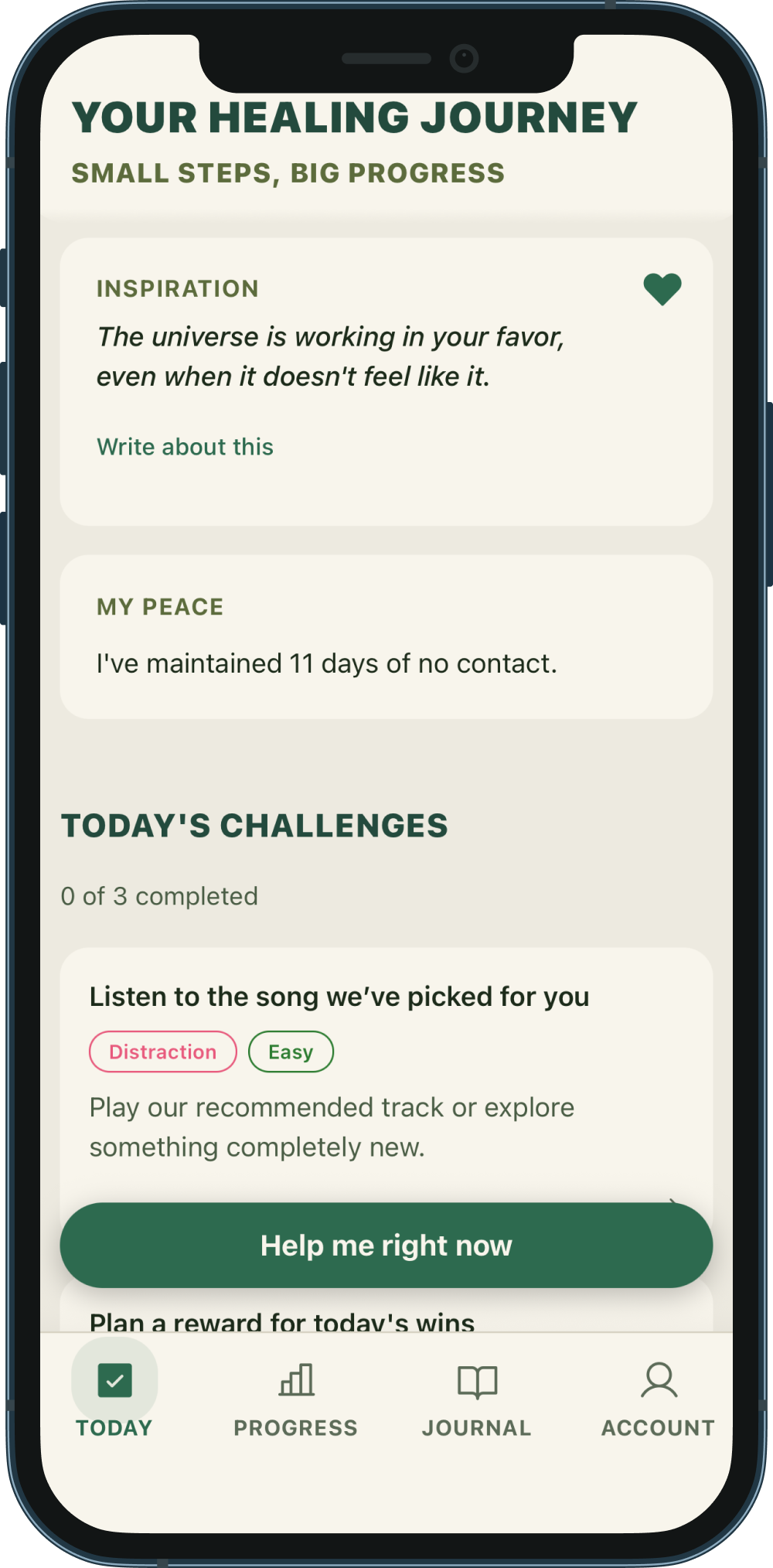
Track it if that helps you. Some people find it motivating to count the days. Breakup Reset has an optional no-contact tracker for that. It is not for everyone. If watching the number climb keeps you going, use it. If a slip makes you feel like you blew it, remember that one message does not erase your progress or mean you failed. You just keep going.
If you slip, note it and move on. One message usually means the urge won that round, not that you are back at square one. What helps is noticing what triggered it: the time of day, a song, a date that means something. That information prepares you for next time, rather than giving you another reason to beat yourself up.

You Do Not Have to Do This Perfectly
Willpower only gets you so far. What helps more is space from someone who still sets you off, until you can come down from that keyed-up state.
You do not have to be perfect at it. The benefit comes from generally seeing less of them, whether or not you count the days.
If you are wondering how long to keep going, see how long should no contact last. When the urge spikes, keeping no contact when it feels impossible and what to do in the next 10 minutes if you want to text are more practical. If full silence is not possible, try low contact or mute vs block.
The discomfort you feel when you stop contact is real. It says something about how much of your daily calm was tied to this person. That tells you how close the relationship was. It is not a countdown for how long recovery will take.
Sbarra, D.A. & Hazan, C. (2008). Coregulation, dysregulation, self-regulation: An integrative analysis and empirical agenda for understanding adult attachment, separation, loss, and recovery. Perspectives on Psychological Science, 3(2), 141-167. / Deci, E.L. & Ryan, R.M. (2000). The ‘what’ and ‘why’ of goal pursuits: Human needs and the self-determination of behavior. Psychological Inquiry, 11(4), 227-268. / Fisher, H.E., Brown, L.L., Aron, A., Strong, G., & Mashek, D. (2010). Reward, addiction, and emotion regulation systems associated with rejection in love. Journal of Neurophysiology, 104(1), 51-60.
Frequently Asked Questions
Does no contact actually work?
It depends what you mean by work. For your own recovery, the evidence is fairly strong: less contact means fewer moments that set off that pull toward your ex, and more room for you to settle. As a tactic to get your ex back, the research does not support it.
What counts as breaking no contact?
Direct contact: texting, calling, or meeting. But checking their social media, asking mutual friends for updates, or looking at old messages can hit you just as hard. No contact works best when you cut off those indirect routes too.
What should I do when I really want to reach out?
Have a plan before the moment arrives, not during it. The urge is usually intense and passes within about 10 to 30 minutes. Put something specific in place for those windows: a walk, a call to a friend, a fixed-time task. You do not need to resist it indefinitely. You just need to get past the next short window.