
How to Cope with a Breakup When You Can't Stop Thinking about Them
Intrusive thoughts after a breakup are common and exhausting. Here is what research says about why they happen and what can interrupt them.

Key takeaways
- Intrusive thoughts after a breakup are one of the most reported parts of the process, and one of the least talked about.
- Your brain is trying to solve something. The loop feels urgent, but it rarely gets you answers.
- Venting, re-reading messages, and asking friends for updates often keep the attachment active.
- Scheduled worry time, brief physical resets, simple tasks, and one timed journal session can break the cycle.
You are in the middle of something ordinary. Making coffee. Driving. Trying to read. And there they are again: their face, a line from a conversation, the version of the breakup where you said the right thing.
Sometimes it is a full replay. Sometimes a single sentence on repeat. You might catch yourself arguing with them in your head, or drafting a message you will never send. You might run through what you should have noticed sooner, or picture them moving on while you stand still. The thoughts can show up when you are alone, but they also cut into work, meals, and sleep.
This is one of the most common parts of a breakup. People talk about the crying and the missing. They talk less about the way your mind will not leave you alone.
Here the focus is the loop itself: what interrupts it when thoughts keep coming back. For timelines, see getting over a breakup. For the first week, see what to do after a breakup.
The thoughts coming back is not a sign something is going wrong.
Why Your Brain Keeps Going Back
Rumination is your mind trying to solve a problem. Something important ended without the resolution your brain expected. So it goes over the same material again, looking for an answer that would make the loss feel manageable.
In studies of depression, Nolen-Hoeksema (1991) found that when people meet distress by turning it over and over in their minds, low mood tends to last longer. Many researchers extend that pattern to breakup rumination, though the original work focused on depressive episodes. It can feel like responsible work, like you are trying to fix something. Often the loop just keeps you stuck.
You might notice the thoughts spike at night, or right after you wake up, or when something small reminds you of them. A song. A restaurant. A friend who still mentions them without thinking. Each of these can set the whole thing off again.
Many people find the thoughts worse when the relationship was long, the breakup was sudden, or they did not get clear answers. Your mind keeps returning to the same questions because it has not found an answer yet: what happened, what you missed, whether it could have gone differently.

What Makes It Worse (Even When It Feels Like It Helps)
Talking about them constantly. You say what hurts, you get some air, you stop for a while. Venting can stretch for hours and end where it started. A friend who listens once is different from a week of retelling the same story with no pause. Your body does not get a break from it.
Re-reading messages or looking at photos. One more look can feel like closeness. It also brings the wanting back. Each time you look, you remind yourself of what you lost and what you still want. You might tell yourself you are looking for evidence or closure. What you often get is another wave of missing them.
Asking mutual friends for updates. Small pieces of information feel harmless. They keep the attachment going. You get a moment of connection without any of the stability that used to come with it. Even neutral news can send you back into guessing: who they were with, what they meant, whether they are doing better than you. If you are wondering whether you could be friends yet, the Am I ready to be friends with my ex? quiz checks whether you are still attached or actually ready.
All of this is normal. It just tends to feed the loop.
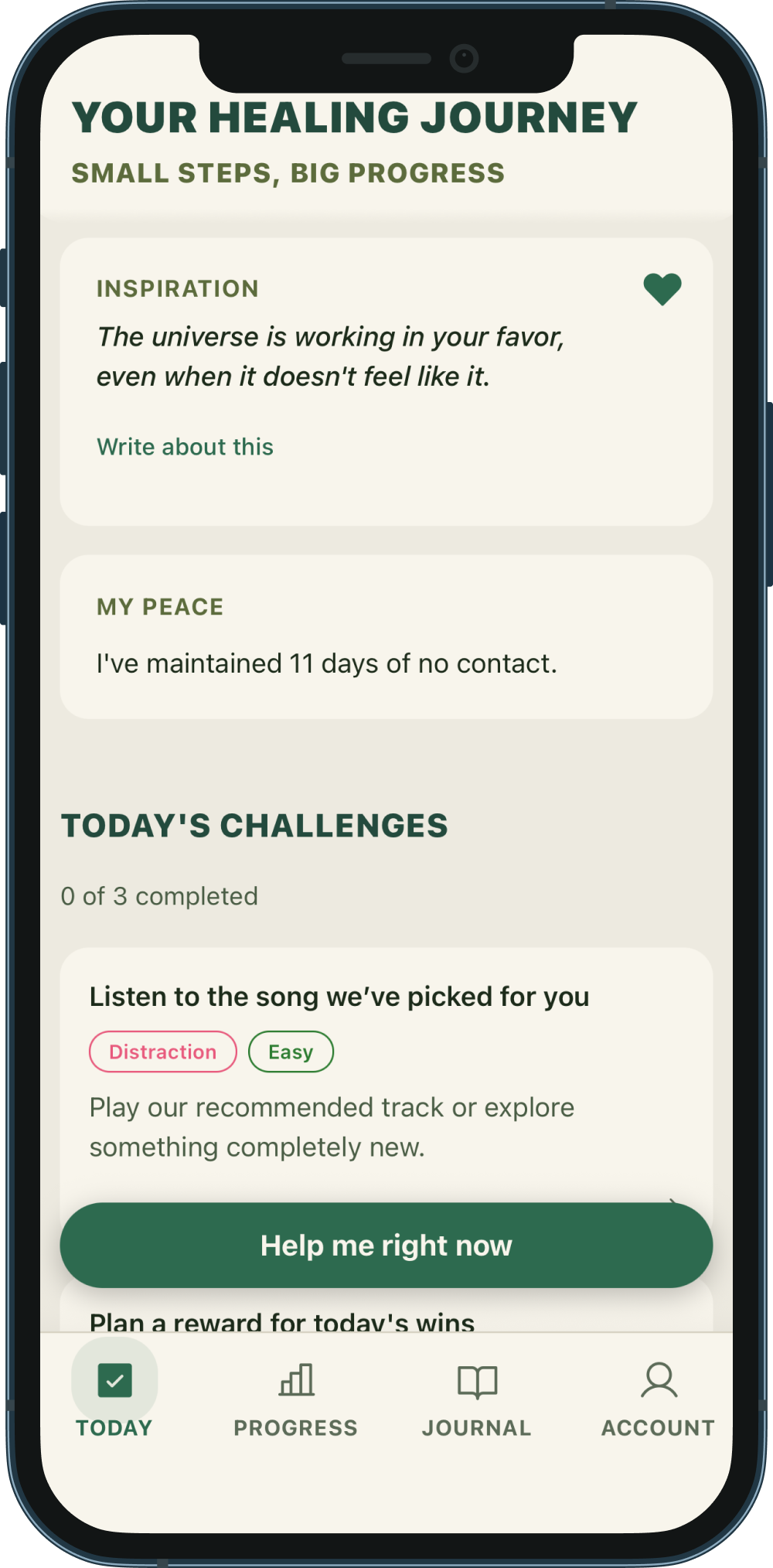
Breakup Reset
Free support for the week ahead
- Completely free
- Three challenges a day
- At your own pace
What Can Interrupt the Loop
Nothing here is a fix. These are things you might try when you notice you are circling the same thoughts again.
Scheduled worry time. Pick a 15 or 20 minute window in the day. During that window, think about the breakup as much as you want. Write, replay, argue in your head. When the window ends, you stop. Outside that window, when the thoughts show up, you tell yourself: not now. Scheduled worry time comes from stimulus control work on worry (Borkovec et al., 1983), used in later cognitive and metacognitive approaches (Wells, 1995). The point is not to push the thoughts away but to stop them from running the whole day. The first few days feel awkward. Most people still find it easier than fighting the same thought every hour.
A brief physical reset. Cold water on your face, a walk around the block, standing up and moving to another room. Even two or three minutes in a different space can take the edge off enough that you can decide what you do next.
Simple tasks for your hands. Cooking, washing dishes, folding laundry, walking without a podcast about relationships. Simple tasks give your mind something else to hold for a few minutes. They work best when the task is concrete enough that you can see progress: a pan washed, a bag taken out, a corner of the room cleared.

Writing it down once. Set a timer for ten or fifteen minutes. Write what you are thinking and feeling. When the timer ends, close the notebook and put it away. Re-reading what you wrote five times in one night usually pulls you back in. One session, then a pause. If you want a starting point, Breakup Reset includes prompted journaling for days when a blank page feels like too much.
Research on recent breakups suggests sadness and anger often ease in stages over time, not all at once (Sbarra, 2006). Small things like these add up. They do not erase the attachment overnight. They make the days more bearable while your brain catches up.
When It Is More Than Thoughts
For many people, intrusive thoughts are miserable but still compatible with getting through the day. You eat sometimes. You sleep sometimes. You show up where you need to.
If weeks go by and you cannot function, if sleep has mostly disappeared, if you are barely eating, that is worth taking seriously. You do not need a label to deserve support. A doctor or therapist can help you work out what makes sense. The same goes if you feel unsafe with yourself. Reach out to someone who can respond in real time.
Grief after a breakup can be intense without being dangerous, and the line is not always obvious. You might think you should be past this by now. Internet timelines are not a real measure. Asking for help is just the practical next step.
Your Brain Has Not Caught Up Yet
The thoughts do not mean you are weak, or that you loved them too much. They mean your brain was attached and has not caught up yet.
For most people it does catch up. In diary studies after breakups, love and sadness often decline over the following weeks, though the pace varies (Sbarra & Emery, 2005). There is no calendar for it, and you do not have to reason your way out of this.
One small thing today is enough: a timed writing session, a walk without your phone, one conversation that does not end back at the breakup.
If the urge to send a message is loud right now, what to do in the next 10 minutes if you want to text your ex can help you ride it out. If nights are when it hits hardest, see breakup anxiety at night.
Nolen-Hoeksema, S. (1991). Responses to depression and their effects on the duration of depressive episodes. Journal of Abnormal Psychology, 100(4), 569-582. / Borkovec, T. D., Wilkinson, L., Folensbee, R., & Lerman, C. (1983). Stimulus control applications to the treatment of worry. Behaviour Research and Therapy, 21(3), 247-251. / Wells, A. (1995). Meta-cognition and worry: a cognitive model of generalised anxiety disorder. Behavioural and Cognitive Psychotherapy, 23(3), 301-320. / Sbarra, D.A. & Emery, R.E. (2005). The emotional sequelae of nonmarital relationship dissolution. Personal Relationships, 12(2), 213-232. / Sbarra, D.A. (2006). Predicting the onset of emotional recovery following nonmarital relationship dissolution. Personality and Social Psychology Bulletin, 32(3), 298-312.
Frequently Asked Questions
Why can't I stop thinking about my ex?
After a close relationship ends, your brain keeps trying to make sense of what happened. That shows up as replay, craving contact, and mental loops. It is tiring, but it is a common response to loss, not a sign that you are broken.
Is it normal to replay conversations after a breakup?
Yes. Many people replay scenes, rewrite endings, or search for the moment things went wrong. The looping often gets worse when the breakup was sudden or when you did not get clear answers.
What helps when rumination will not stop?
Small shifts can help: a set time to worry, a physical reset like cold water or a walk, a simple task for your hands, or one timed writing session instead of looping in your head.