
Getting over a Breakup: What the Research Actually Says
Most breakup timelines you read online are invented. Here is what grief and relationship research actually shows about recovery, and why it is probably better news than you think.

Key takeaways
- Most breakup timelines online are not based on research.
- People tend to overestimate how bad recovery will feel and how long it will last.
- Bad days after good ones are normal, not a sign you are sliding back.
- More people follow a resilient path than pop psychology suggests.
- Making sense of what happened, rebuilding who you are, and steady contact with people who know you all help.
You have probably read that it takes half the relationship to get over someone, or that there are five stages, or that you just need a month. Most of those frameworks were not built from relationship research. They were borrowed, simplified, or invented, and they tend to make people feel worse when their own experience does not match.
Here the focus is simpler: how long recovery tends to take, and what the evidence actually shows.
If you need first-week steps, start with what to do after a breakup. If the thoughts will not stop, see how to cope when you cannot stop thinking about them. If you feel like you are going backwards, see how to heal when progress feels circular.
People Tend to Overestimate How Bad It Will Be
One of the more striking findings in this area comes from a study by Eastwick and colleagues (2008). They tracked people before and after a breakup and found that people significantly overestimated both how distressed they would feel and how long that distress would last.
That does not mean breakups are easy. It means our predictions about our own suffering tend to run ahead of the actual experience. Many people, once in the middle of recovery, are doing better than they thought they would be at this point.

How Long It Actually Takes
There is no single answer, and any source that gives you a clean timeline is guessing. What research does suggest is this:
Longer, more intertwined relationships take longer. When two lives are bound together through shared routines, friends, a home, finances, untangling that takes more time. That is structural, not a sign that you are handling it badly.
The nature of the ending matters. Ambiguous endings, ones with no real conversation, that faded rather than finished, tend to keep the loop open longer. There is less to anchor the grief to. Clear endings, even painful ones, tend to close faster.
What you do early has an effect. Both extremes tend to slow recovery: avoiding any reminder of the relationship, and spending most of your time replaying it. People who find some middle ground, who let themselves feel without living entirely inside the feeling, tend to move through it more steadily.
What Recovery Actually Looks Like
Most people expect a downward slope: bad at first, steadily better. The reality tends to be spikier. Good days followed by bad ones. A week where you feel okay, then something small catches you off guard and you are back in it.
That is not regression. Research on grief and resilience suggests that oscillating between distress and ordinary functioning is the usual pattern (Bonanno, 2004), not a sign something has gone wrong.
Bonanno’s work is also useful on another point. More people follow what he calls a resilient trajectory than most accounts of breakup recovery assume: brief distress, then a fairly steady return toward baseline. That does not mean suppressing feelings or pretending nothing happened. It means that humans are more adaptable than they tend to credit themselves for. The prolonged, destabilising grief that feels like the obvious outcome is, in fact, less common than the research suggests.
Recovery also does not mean forgetting. You can remember the relationship clearly, understand what it meant, and still feel okay. The two are not in tension.
Why Some People Take Longer
Attachment style. People with more anxious attachment tend to ruminate more, seek reassurance more, and find it harder to tolerate the uncertainty of a breakup. Research consistently links anxious attachment to longer and more intense post-breakup distress. That is a pattern, not a verdict on your character, and patterns can shift.
Social support. Having access to people who will listen without immediately pressuring you to feel better, or telling you what you should do, appears to be protective. This is not about how many people you know. One person who actually listens is more useful than fifteen who tell you to move on.
The ambiguity of the ending. When there was no real conversation, when things faded out, when you are left without a clear account of what happened, the mind keeps searching for answers. That keeps the grief active longer than a clear, even painful, ending tends to.
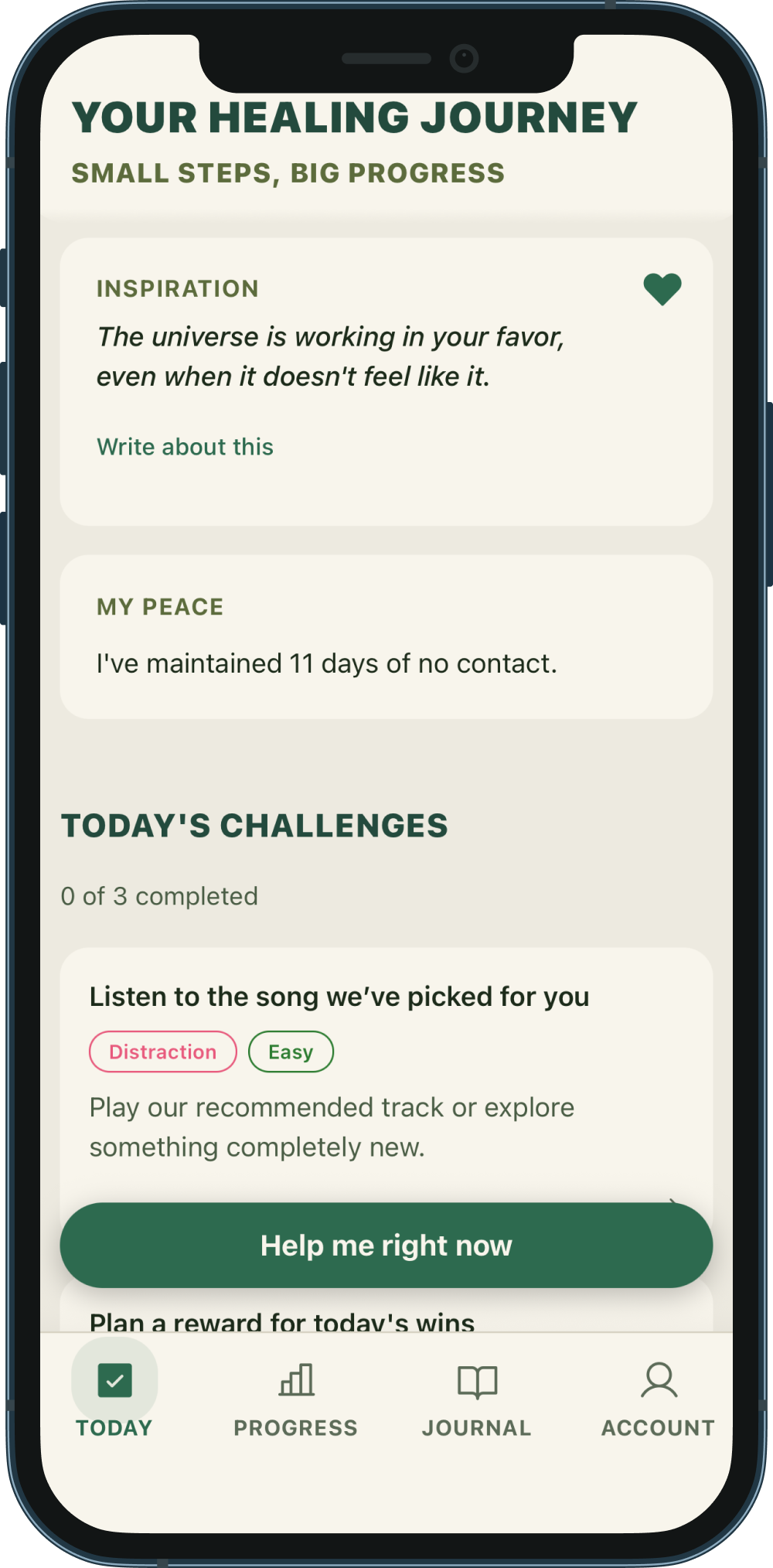
How people differ in recovery patterns partly comes down to these factors working together. Tools like Breakup Reset use a short quiz to help you see which patterns are most relevant for you, so suggestions are matched to your situation rather than generic.
Breakup Reset
Free support for the week ahead
- Completely free
- Three challenges a day
- At your own pace
What Actually Helps
Making sense of what happened. Not in a toxic-positivity way, not hunting for silver linings. Research on meaning-making after loss suggests that people who can arrive at some account of what happened, even a messy one, tend to recover more steadily than those who cannot. A working explanation is enough for now.
Rebuilding your sense of who you are. A study by Slotter, Gardner, and Finkel (2010) found that breakups are associated with reduced self-concept clarity, a less stable and clear sense of who you are. People who showed lower clarity reported more distress. Rebuilding that clarity, figuring out who you are outside this relationship, matters for recovery because part of your identity was tied to the relationship, and that part needs reconfiguring.

Staying in contact with people who know you. Not constant distraction. Not isolation. Regular, ordinary time with people who knew you before the relationship and know you now. This serves two functions: it provides the social support that research links to better recovery, and it reinforces a sense of self that is not entirely defined by the loss.
There Is No Correct Timeline
If you are wondering whether to start dating again, what research says about dating after a breakup looks at rebound studies and motivation without a three-month rule.
The research on this is, on balance, encouraging. Most people recover. Most people recover faster than they predicted they would when they imagined the breakup in advance. Most people follow a resilient path, even if it does not feel that way in the middle of it.
None of that tells you how long your recovery will take, because it depends on the length and nature of the relationship, your attachment patterns, your social support, and what you do now. But the odds are better than they feel.
If you are weeks or months in and still struggling, that is within normal range. If it has been a long time and you cannot function, that is worth getting support for. The difference between difficult grief and something that needs more help is mainly about duration and severity, not about feeling bad at all.
You are probably further along than it feels right now.
Eastwick, P.W., Finkel, E.J., Krishnamurti, T., & Loewenstein, G. (2008). Mispredicting distress following romantic breakup: Revealing the time course of the affective forecasting error. Journal of Experimental Social Psychology, 44(3), 800-807. / Bonanno, G.A. (2004). Loss, trauma, and human resilience. American Psychologist, 59(1), 20-28. / Slotter, E.B., Gardner, W.L., & Finkel, E.J. (2010). Who am I without you? The influence of romantic breakup on the self-concept. Personality and Social Psychology Bulletin, 36(2), 147-160.
Frequently Asked Questions
How long does it take to get over a breakup?
It varies widely, and most timelines you find online are not based on research. Longer, more intertwined relationships tend to take longer. People also tend to overestimate how bad and how long the distress will be before it actually happens.
Is it normal to still feel bad weeks after a breakup?
Yes. Recovery is not a straight line. Most people have good stretches interrupted by bad days, and that does not mean they are sliding back. It is how the process tends to go for most people.
Why do some people seem to recover faster?
Access to good social support, a clearer ending, and a more secure attachment style all appear to help. What you do in the first few weeks matters too: both constant rumination and shutting everything out tend to slow things down.