
When You Can't Function after a Breakup: How to Get Through the Day
Not being able to work, eat, or get out of bed after a breakup is more common than people say. Here is what is happening and what actually helps when you are at the floor.

Key takeaways
- Not being able to do basic things after a significant breakup is a common biological response, not a sign of weakness.
- The bar for functioning is lower than you are probably setting it: eat something, sleep, do the minimum required task.
- Behavioral activation, acting before motivation arrives, is the only way through the low-motivation state.
- Three areas to focus on: body maintenance, one small task completed, one person who knows how you actually are.
- If the inability to function persists beyond two to three weeks, that is worth getting professional support for.
Not being able to do the basic things, eat properly, concentrate at work, reply to messages, get out of bed at a reasonable hour, is one of the most common experiences after a significant breakup. Almost nobody talks about it. So it can feel like something is specifically wrong with you, like everyone else manages to keep going and you cannot.
It is not. This is more common than it appears. But it is genuinely hard, and it deserves to be taken seriously.
Why Grief Can Shut the Body Down
The attachment system in alarm state affects more than emotions. Fisher et al. (2010) found that romantic rejection activates the same reward and craving circuitry involved in other forms of craving and withdrawal. When that circuitry is disrupted, when the person who was a source of regulation is suddenly absent, sleep, appetite, concentration, and motivation are all affected. This is a biological response, not a weakness.
Low motivation after loss is not laziness. Martell, Addis and Jacobson (2001) describe how this works in depleted states: the motivation does not come back and then allow you to act. You act first, with whatever minimal capacity you have, and that action slightly improves the state, which makes the next action marginally less hard. The loop starts with the action, not the feeling. Waiting for motivation to return before you do anything keeps you in the state you are already in.

What Functioning Can Realistically Mean Right Now
The bar is probably lower than you are setting it.
You do not need to be performing at your usual level. You do not need to be healing AND managing everything well at the same time. You do not need to look okay to people who are watching.
What you need to do:
- Eat something today. Anything.
- Sleep, even badly, even broken.
- Do the minimum required task at work or at home. One thing.
- Not make any major decisions while you are this depleted.
That is functioning. That is enough for now. You do not owe anyone more than that.
The Smallest Possible Actions
Not a recovery plan. Not a program. Three areas, each with the lowest possible bar.
Body. Eat something warm if you can manage it. Twenty minutes outside, not a workout, just outside. Shower. These are not rituals. They are biological floor maintenance, and they count as progress whether they feel like it or not.
Mind. One small task completed. Dishes. One email answered. A surface cleared. The bar is low because the bar matters. Completing one thing, anything, starts to shift the activation loop. Not because it is meaningful. Because the nervous system registers completion.
Connection. Tell one person how you actually are. Not a group chat, not a performance. One person. “I’m not doing great” is enough. You do not have to explain everything. Staying loosely connected stops isolation from compounding the shutdown.
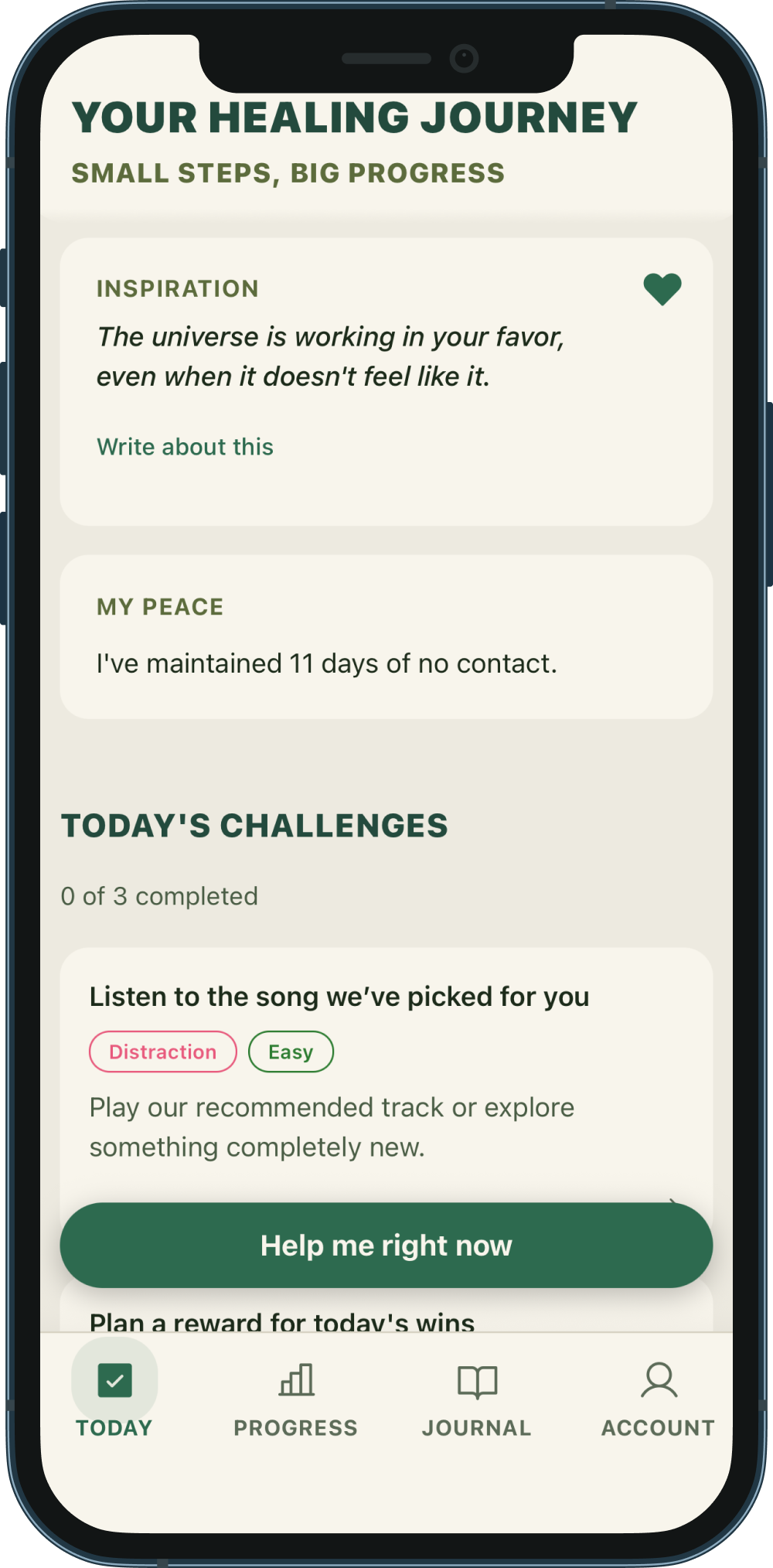
Breakup Reset is built for exactly this state. The Reset Builder type starts from where you are. The self-care challenges hold the floor: eat something, move a little, basic maintenance that counts. The rebuilding challenges create the smallest possible activation step above that. Neither asks you to feel better first. Both ask for one small thing. That is the whole design.
Breakup Reset
Free support for the week ahead
- Completely free
- Three challenges a day
- At your own pace
When to Get More Help
If you have not been able to eat, sleep, or get through the minimum required daily tasks for more than two to three weeks, if this is not a bad week but an extended period with no lighter stretches, that is worth talking to a doctor or therapist about.
Breakup grief and clinical depression can look similar. They can also occur at the same time. Both are real. Both are treatable. You do not need to wait until you are in crisis to ask for support. The fact that it started with a breakup does not mean it cannot also be something that needs more than time.
The floor is not always a breakup floor. If you are not sure whether what you are experiencing is typical grief or something more, a single conversation with a doctor is enough to find out.
The Floor Is Not Permanent
You do not need to get off it today. You need to do one thing. Then tomorrow, one more thing.
Not a transformation. Not a recovery arc. One thing.
That is what getting through this looks like from here.
When you can lift your head a little, what to do after a breakup covers the first week. When the waves come back later, emotional overwhelm after a breakup can help.
Fisher, H.E., Brown, L.L., Aron, A., Strong, G. & Mashek, D. (2010). Reward, addiction, and emotion regulation systems associated with rejection in love. Journal of Neurophysiology, 104(1), 51–60. / Martell, C.R., Addis, M.E. & Jacobson, N.S. (2001). Depression in Context: Strategies for Guided Action. W.W. Norton. (behavioral activation principle; developed in depression context.) / Bonanno, G.A. (2004). Loss, trauma, and human resilience. American Psychologist, 59(1), 20–28.
Frequently Asked Questions
Is it normal to not be able to function after a breakup?
Yes. Not being able to concentrate at work, eat normally, sleep well, or get out of bed is one of the most common experiences after a significant breakup, and one of the least talked about. The attachment system in alarm state affects sleep, appetite, motivation, and concentration as predictable biological responses, not signs of weakness. Most people who go through this recover. It usually improves before it feels like it will.
What counts as functioning when you are at your lowest?
Eat something today. Sleep, even badly. Do the single most necessary thing at work or at home. Do not make any major decisions. That is functioning. You do not need to be performing at 80% and healing at the same time. The bar is lower than you are probably setting it.
When should I see a doctor or therapist about how I am feeling?
If you have not been able to do basic things, eat, sleep, get through the minimum required tasks, for more than two to three weeks, that is worth getting support for. Breakup grief and clinical depression can look similar and can overlap. Both are treatable. You do not need to wait until you are in crisis. If it has been more than a few weeks and the floor is not lifting at all, please talk to someone.