
Breakup Advice That Does Not Make You Feel Worse
Most breakup advice is well-meaning and still misses the mark. Here is what tends to backfire, what research supports, and how to spot advice that fits you.

Key takeaways
- Just move on, stay busy, and love yourself often miss where you actually are.
- Staying busy as a main strategy can push feelings down until they come back louder.
- Short expressive writing, quiet company, and movement have research behind them.
- Good advice gives you one small step for today, not a timetable for your feelings.
- If advice does not fit your situation, you can trust that instinct.
You have probably heard it already. Just move on. Love yourself. Stay busy. Get back out there. You will be fine.
Sometimes it comes from people who care about you. Sometimes from articles that mean well. And sometimes it lands like a wall: as if the problem is that you are taking this too seriously, or not recovering with enough enthusiasm.
If standard breakup advice has made you feel worse, that reaction is worth trusting.
This is about the advice itself: what tends to backfire, what has some evidence behind it, and how to tell what fits you. If you need something more concrete for the first week, start with what to do after a breakup.
A lot of generic tips fail not because you are broken, but because they skip where you actually are.
Why So Much Breakup Advice Backfires
Just move on treats grief like a switch. It asks you to skip the part where you register what you lost. That rarely ends the feeling. It often postpones it until you are alone at night with nothing to distract you.
Stay busy sounds practical. Used as a main strategy, it can turn into suppression: every hour filled so you never have to sit with what happened. Wegner (1994) described how trying not to think about something can keep it circling back. Many people find that the thoughts they outran show up later as intrusive loops, often at night or in quiet moments.
You will be fine is not wrong on a long enough timeline. As comfort in the middle of the wreckage, it can feel like your current pain got waved away. You needed someone to acknowledge that today is hard, not that someday will be easier.
One-size-fits-all tips ignore how differently people cope. Some need company. Some need quiet. Some feel numb first and wrecked later. Advice written for an imaginary average person will miss you.
If you want a first-week frame that stays closer to what people actually go through, what to do after a breakup walks through that without the cheerleading.
What Actually Has Some Evidence Behind It
Short expressive writing. Pennebaker and Beall (1986) found that writing about a difficult event for roughly 15 to 20 minutes over a few days can reduce distress for many people. Think focused writing about what happened and what you are carrying, not a daily feelings diary unless you want that. One timed session can be enough to start.
Company without a lecture. Passive support, someone who stays nearby without fixing or coaching, often helps more than a list of tips. You do not need someone to explain your breakup to you. You need someone who can tolerate you being not okay for a while.
Moderate movement. Exercise shows up in mood research, mostly in studies of depression rather than breakups (Babyak et al., 2000). A walk, a swim, anything that gets your body involved can lower stress and shift your state a little. It works best as a regular small habit, not as a way to avoid feeling anything.
Letting yourself feel it. Suppressing grief tends to create a rebound. That does not mean drowning in it all day. It means not treating every hard feeling as proof you are failing. How to cope when you cannot stop thinking about them goes into the thought loops and what can interrupt them without pretending they should vanish.

What Good Advice Actually Sounds Like
It does not assign you a feeling or a deadline. It does not tell you that you should be over them by now, or that missing them means you made the wrong call.
It gives you something small for today. Not a 90-day plan. A walk. A text to one person. One writing session with a timer. One hour without checking their profile.
It treats you as the expert on your own life. You know how entangled the relationship was, how the ending happened, what you can handle this week. Advice that ignores that context is generic for a reason.
It makes room for mixed feelings. You might miss them and know it was right to leave. You might feel relieved and guilty about the relief. You might feel flat for weeks and wonder if something is wrong with you. None of that means the advice you received was meant for you.
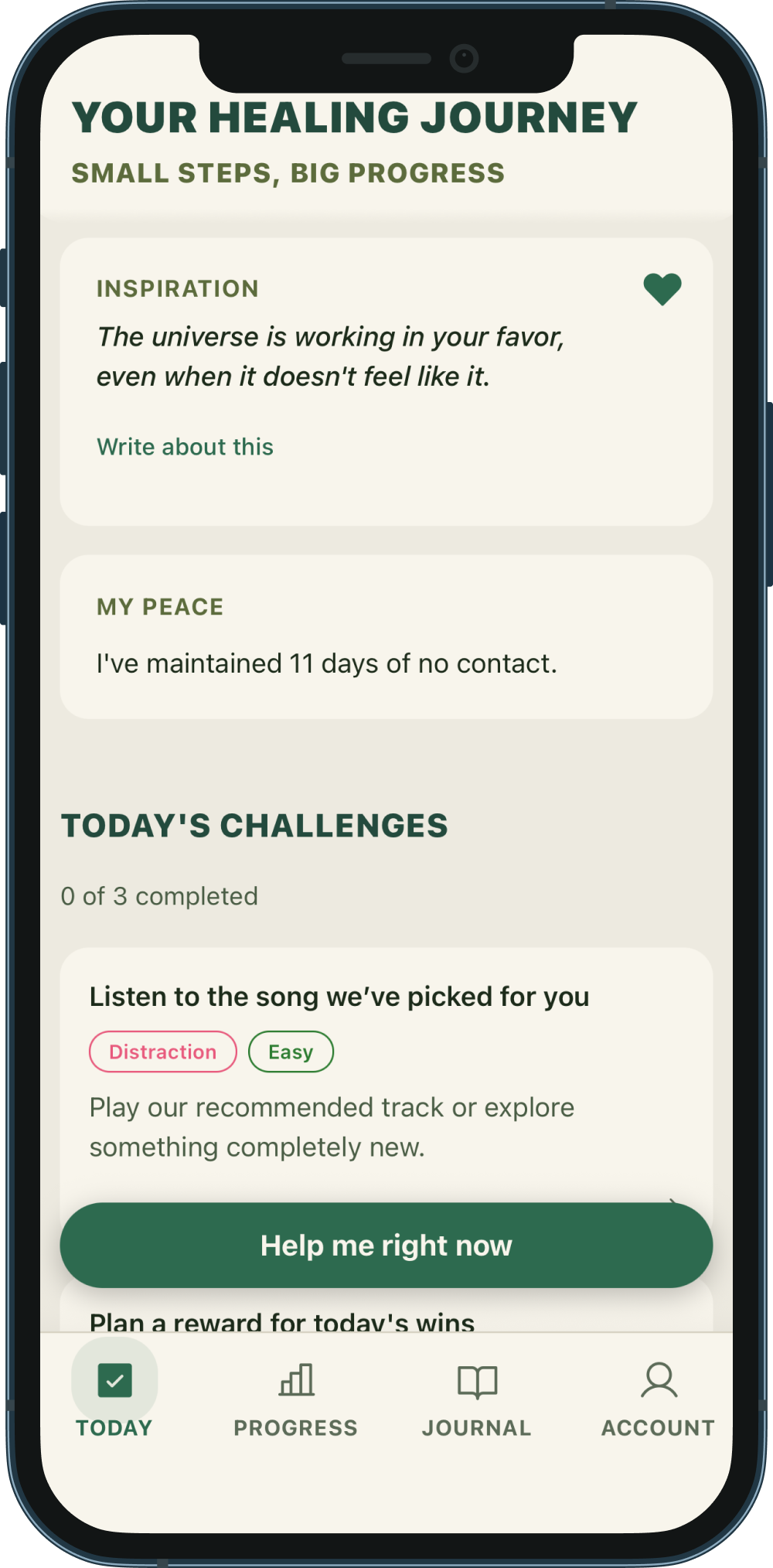
Breakup Reset is built around that idea: low-pressure daily structure instead of a recovery script. Short challenges, optional journaling, breathing tools when the urge hits, and a quiz that matches suggestions to how you tend to cope. One option among many, built to fit your week rather than hand you a script.
Breakup Reset
Free support for the week ahead
- Completely free
- Three challenges a day
- At your own pace
Trust What Lands and Drop What Does Not
The best breakup advice is the advice that fits your situation, your history, and how you actually cope. If something makes you feel smaller or more rushed, it probably was not written for you.
You do not owe anyone a performance of moving on. You do not have to defend why the generic tips did not work. Most people need time, support, and a few small things that help on a ordinary Tuesday, not a slogan.
If you want the longer view on timelines and what recovery tends to look like over months, getting over a breakup lays that out without promising a clean finish line.
Pennebaker, J.W. & Beall, S.K. (1986). Confronting a traumatic event: Toward an understanding of inhibition and disease. Journal of Abnormal Psychology, 95(3), 274-281. / Wegner, D.M. (1994). Ironic processes of mental control. Psychological Review, 101(1), 34-52. / Babyak, M., Blumenthal, J.A., Herman, S., Khatri, P., Doraiswamy, P.M., Moore, K., Craighead, W.E., Baldewicz, T.T., & Krishnan, K.R.R. (2000). Exercise treatment for major depression: Maintenance of therapeutic benefit at 10 months. Psychosomatic Medicine, 62(5), 633-638.
Frequently Asked Questions
Why does breakup advice make me feel worse?
A lot of it asks you to skip steps you cannot skip, or assumes you should feel ready before you do. Advice that tells you to move on, stay busy, or love yourself harder often lands as judgment, even when the person means well.
What breakup advice actually helps?
Things with some research behind them include short writing sessions about what happened, company that does not push you to cheer up, moderate movement, and room to feel bad without treating it as failure. Small and doable beats a full recovery program.
Is it bad that I still miss my ex?
Missing someone and knowing the relationship needed to end can both be true. Good advice makes room for mixed feelings instead of telling you which ones are allowed.