
What to Do after a Breakup: a Realistic First Week Guide
The first week after a breakup is hard and messy. Here is what actually helps, based on grief research and what people go through.

Key takeaways
- The first week is often the hardest. Sleep disruption, appetite changes, and compulsive phone-checking are common and have a biological basis.
- Checking their social media and sending the “I just want to understand” message both tend to make things worse.
- Small, boring acts help more than grand gestures: one person to talk to, something to eat, a short walk, a couple of things on your to-do list.
- Days three to seven often bring the urge to reach out. Having a plan for that moment matters.
You probably did not sleep well. You might have eaten something odd, or nothing at all. You have checked your phone more times than you want to count, and each time it was either them or it was not, and neither felt okay.
On day one or two, the tiredness, the stomach knots, the restless checking: that is your body reacting.
Why the First Week Feels So Extreme
When a relationship ends, your brain does not quietly update and move on. Research on rejection and the brain (Fisher et al., 2010; Kross et al., 2011) shows that losing a close attachment activates regions tied to distress, craving, and reward. Your mind keeps looking for something it expected to find.
Sleep gets messy. Food tastes wrong or does not appeal. Focus disappears. You are not being dramatic.
This does not mean the week ahead will be like day one. The most intense part tends to be early. Your system does settle, even if it does not feel that way right now.

What Not to Do (and Why It Is So Tempting)
Checking their social media. You already know this probably will not help. What is harder to see is why you keep doing it anyway. Each time you check, you get a brief moment of feeling close to them, followed by a longer stretch of feeling worse. It feeds a stress loop, not closure. Muting, unfollowing, or temporarily blocking can help protect you.
Sending the “I just want to understand” message. Most of the time you want contact, reassurance, or a way to undo the distance, not information. The conversation rarely delivers what you need, and it often restarts the pain cycle. If you have something specific and important to say, it can wait a few days.
Making big decisions. The first week is not a good time to cut off all mutual friends, post something you might regret, or quit the hobby you shared. These decisions tend to feel urgent and necessary right now. Most of them are not. Give yourself a week before acting on anything that cannot be undone.
If you cannot go fully no contact because of kids, work, or shared friends, should you do no contact covers practical boundaries instead of an all-or-nothing rule.
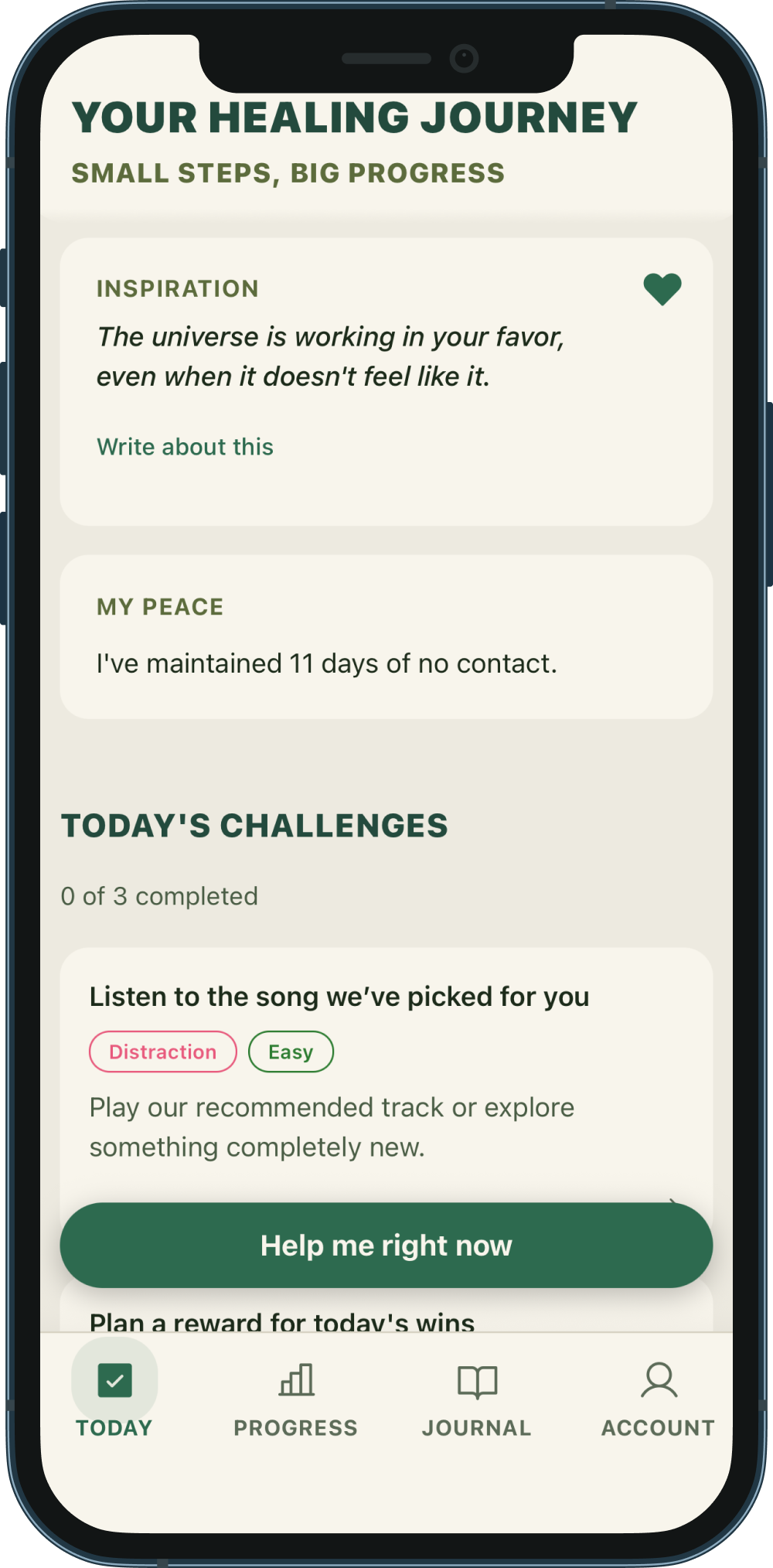
Breakup Reset
Free support for the week ahead
- Completely free
- Three challenges a day
- At your own pace
What Actually Helps in the First Few Days
Sleep. Even bad sleep is better than none. Keep your room cool. Charge your phone in another room if you can. You will not sleep perfectly, and that is okay.
Eating something. You do not need a nutrition overhaul or a self-improvement plan. Eat something today. Something warm usually helps, but anything is fine.
One person to talk to. Pick one person, not a group chat or a social media post. Someone who will listen without immediately trying to fix you or rush you to feel better. If you do not have that person right now, you do not have to solve it this week.
Moving your body. You do not need a gym or a special workout. If you already had a movement routine, try to keep it, but be easy on yourself on the days you cannot. If you did not have one, a short walk is enough.

One or two things on your list. Even two things you are going to do today cuts down the empty time your brain fills with replaying things. They do not need to be productive.
What Days Three to Seven Usually Look Like
There will probably be some moments of okay-ness. A few hours where you forget, or something catches your attention, or you feel almost normal. They may not last.
Then there will be a wave. Something reminds you, and it hits again. For a lot of people, the first week moves in spikes and brief calms, with the calms getting a little longer.
The urge to reach out often peaks somewhere in days three to five. If you know that is coming, it is worth having a small plan: what will you do in the next twenty minutes instead? Write it down. Tell one person. Have something ready.
Social pressure is also real in this window. Friends who care about you may push you to feel better faster than you actually do. Tell them where you are. You do not have to perform recovery.
The Week Is Not a Verdict
One week does not define how long this takes or how hard it will be. Most people find the acute phase eases after the first week or two.
Getting through the first week in one piece matters, even if you cried, struggled, or made a few choices you would have done differently.
You already did one day. That counts.
If you want the longer view on timelines, see getting over a breakup. If you can barely get through the day, start with when you cannot function after a breakup. If nothing lands at all, see feeling numb after a breakup. If you were the one who ended it, grieving a breakup you chose speaks to that. If who you are feels scrambled, try identity after a breakup. If writing helps, private breakup journaling covers why the page should stay yours.
Fisher, H.E. et al. (2010). Reward, addiction, and emotion regulation systems associated with rejection in love. Journal of Neurophysiology, 104(1), 51-60. / Kross, E. et al. (2011). Social rejection shares somatosensory representations with physical pain. PNAS, 108(15), 6270-6275. / Bonanno, G.A. (2004). Loss, trauma, and human resilience. American Psychologist. / Sbarra, D.A. & Hazan, C. (2008). Coregulation, dysregulation, self-regulation. Perspectives on Psychological Science.
Frequently Asked Questions
Why do I feel physically sick after a breakup?
Your brain treats the loss of a close relationship as a real alarm. Sleep, appetite, and focus can all break down at once. It is a predictable response, not a sign that something is wrong with you.
Should I reach out to my ex in the first week?
For most people, early contact keeps the stress response active and makes the first week harder. If you feel the urge to reach out, having a small plan for what to do instead helps.
How long does the worst part last?
The acute phase is usually most intense in the first few days. Most people notice some stabilization after the first week, though it varies. One week does not define the whole process.