
Getting Over a Long-Term Relationship: Why It Takes Longer and What Actually Helps
Ending a long relationship is not just losing a person. It is losing a whole life structure. Here is why it takes as long as it does, and what recovery actually looks like.

Key takeaways
- Long relationships involve structural loss, shared routines, social network, future plans, and identity built in partnership.
- Self-concept clarity, a stable sense of who you are, drops after longer relationships and takes time to rebuild.
- Nonlinear recovery (good weeks, then a setback) is the norm for long relationships, not a sign of failure.
- Small structure that belongs to you, not to the relationship, is more useful than transformation plans.
- The grief takes as long as it takes; its length is proportional to what was there to lose.
This is not your first breakup. You have been through shorter ones, or at least ones that felt more manageable. You know roughly what getting over someone looks like. And this one is different, bigger, slower, stranger. You keep finding grief in places you did not expect. Things that seemed small feel surprisingly hard. The timeline you assumed does not hold.
That is not because you are doing it wrong. It is because a long relationship is a different kind of loss.
Why Long Relationships Leave a Different Kind of Grief
A short relationship ends and you lose the person. A long relationship ends and you lose a structure.
Shared routines: the shape of a morning, who cooks on which nights, the way weekends were organized. Shared social world: mutual friends who now have to navigate both of you, or who disappear. Shared identity: the way you described yourself in the presence of someone who knew you deeply. Shared future: the plans, the plans-adjacent daydreams, the version of the next five years that no longer exists.
These are not abstract losses. They are practical reorganizations that happen at the same time as the emotional one.
Slotter, Gardner and Finkel (2010) found that breakup distress was associated with lower self-concept clarity: a less stable and coherent sense of who you are. And they found that this effect was stronger for longer relationships, because more of the self had been developed within the partnership. When the partnership ends, the parts of the self that were defined in relation to it need reconfiguring. That takes time that has nothing to do with how well you are grieving.
The Identity Loss Piece
This is what makes long-relationship breakups distinct from shorter ones, and it is worth naming directly.
In a long relationship, you become partly a person who is with this person. Your routines, your aesthetic choices, your social world, your sense of the future, all of these develop partly in the context of the relationship. That is not dependence. It is the natural result of sharing a life.
When the relationship ends, the question “who am I without them” is not melodrama. It is a real, practical question. Some of what you knew about yourself was known in reference to them. Who are you at a restaurant alone. What do you do on Sunday morning. What do you want when no one else’s preferences are in the room.
This reconfiguration is structural, not psychological weakness. It is what needs to happen, and it takes as long as it takes. The journal is useful here, not as processing of the loss, but as a genuine inquiry: what do I actually like, want, think, need, when I am not organizing those things in relation to someone else.

Why Recovery Seems Nonlinear
You have good weeks. Something clicks. You are moving, socializing, starting to feel like a version of yourself. And then something trips a wire. An anniversary you had half-forgotten. A song that was background music on a particular trip. A city, a smell, a notification from a mutual friend.
And you are back, or something like it. The grief that had quieted surfaces again.
This is not regression. It is not a sign you have undone the progress you made. Bonanno (2004) describes oscillating trajectories as the documented norm in grief research, most people who recover well move between distress and relative stability, not along a straight improving line. Long relationships have more surface area. More association points. More of the shared history that can surface unexpectedly. The nonlinear pattern is more pronounced, not because you are grieving worse but because there is more to grieve.
What Structure Actually Does
When the external structure of daily life, the routines, plans, and habits that were organized around another person, disappears, internal structure becomes more important. Not productivity. Not building yourself. Just: having a few things in the day that belong to you.
This is not about filling the space the relationship occupied. It is about creating small, low-pressure things that are yours now, not the relationship’s, not shared, not inherited from whoever you were in that partnership.
A regular time for something small: a walk, a meal you make for yourself, a weekly thing you choose. Not meaningful in themselves, necessarily. Just present, yours, and consistent.
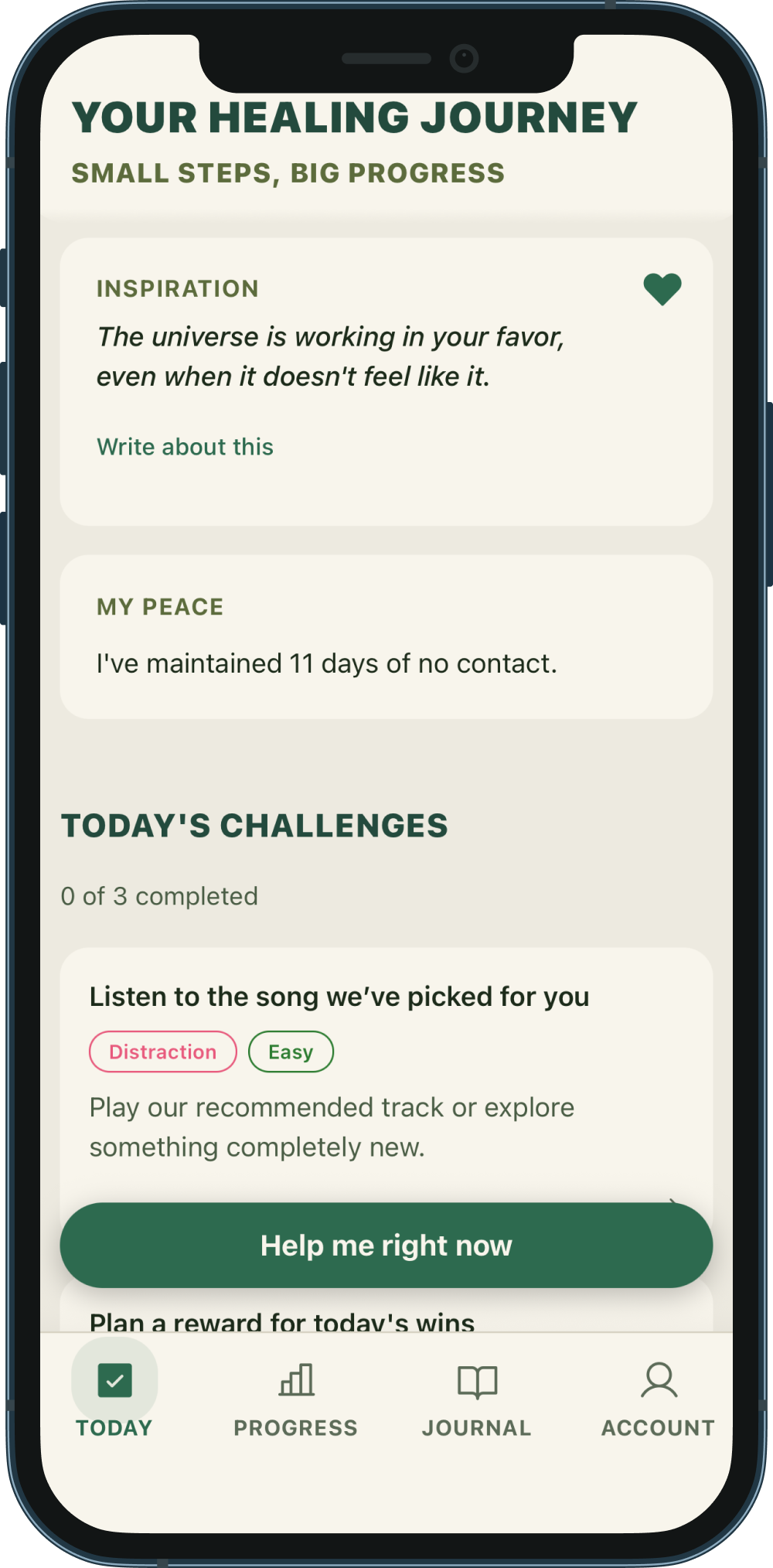
Breakup Reset offers a daily structure for people rebuilding a day that used to be organized around someone else. For a long-term relationship, the rebuilding challenges are the most important category first: small routines that now belong to you. The discovery challenges become more relevant as the weeks pass: identity, what you want, who you are without that shared context. Not to rush the answer. To start asking the question.
Breakup Reset
Free support for the week ahead
- Completely free
- Three challenges a day
- At your own pace
Timeline Honesty
Relationship length is one of the stronger predictors of recovery duration in breakup research. This is not surprising. More time together means more to reorganize. The attachment had more time to form. There was more to build, so there is more to take apart.
There is also this: Wilson and Gilbert (2003) found that people consistently overestimate how long and how intensely they will feel bad after negative life events. The prediction is worse than the reality. But for long relationships, the reality is still substantial, even accounting for that overcorrection. Knowing you will likely recover faster than you currently believe does not make the current period shorter.
You are not behind. You are doing something that takes as long as it takes.
The Length of the Grief Is Proportional to What Was There to Lose
You are not grieving longer than you should be. You are grieving at the scale of what was there.
The longer the relationship, the more there is to reorganize, emotionally, practically, and in terms of identity. That reorganization is not something you can accelerate beyond a certain point. You can create better conditions for it. You can avoid the choices that slow it down. But the timeline is your nervous system’s, not yours to set.
For more on recovery timelines generally, getting over a breakup covers the research on how long things actually take. And if part of what you are carrying is who you were in the relationship and who you are now, how to heal from a breakup goes deeper into the identity rebuilding work.
Slotter, E.B., Gardner, W.L. & Finkel, E.J. (2010). Who am I without you? The influence of romantic breakup on the self-concept. Personality and Social Psychology Bulletin, 36(2), 147–160. / Wilson, T.D. & Gilbert, D.T. (2003). Affective forecasting. Advances in Experimental Social Psychology, 35, 345–411. / Bonanno, G.A. (2004). Loss, trauma, and human resilience. American Psychologist, 59(1), 20–28. / Sbarra, D.A. & Hazan, C. (2008). Coregulation, dysregulation, self-regulation. Perspectives on Psychological Science, 3(2), 141–167.
Frequently Asked Questions
Why does it take so much longer to get over a long-term relationship?
A long relationship is not just emotional. It is structural. Shared routines, social networks, financial arrangements, and future plans were all organized around another person. When it ends, you are not just processing the loss of the person; you are reorganizing daily life, identity, and sometimes practical reality simultaneously. Research suggests relationship length is one of the stronger predictors of recovery duration. This is structural, not a measure of weakness.
What is identity loss after a long relationship?
In a long relationship, some of who you are develops in partnership: your tastes, routines, how you describe yourself, what you imagine your future looks like. When the relationship ends, that part of the self needs reconfiguring. This is not the same as having lost yourself. It is having built some of yourself with someone, and that part needing to be reconstructed. It is practical, structural, and workable, but it takes time.
Is it normal to have a setback months after a long-term breakup?
Yes. Long relationships have more surface area, more shared history, more shared objects, more dates and places that carry association. A song, an anniversary, a city you visited together can open grief that had been quieter. This is not regression. It is the density of the shared history surfacing. Most people who recover from long-term breakups do so in a nonlinear way.