
How to Heal from a Breakup When You Feel Like You Are Going Backwards
You were doing okay until a song or a place pulled you back in. That bad stretch does not mean you failed. Most people heal in waves, not a straight line.

Key takeaways
- Good days followed by hard ones are common, not failure.
- Triggers like songs or places can reopen the loss without erasing progress.
- Recovery tends to look like waves that get shorter over time.
- Small regular actions matter more than big gestures.
- Circles with a shrinking radius still count as movement forward.
You were doing okay. Maybe even genuinely okay for a few days. Then a song came on, or you walked past the cafe where you used to meet, or it was simply a Tuesday, and you were right back in it.
It has been six weeks, or three months, or longer, and you thought you would feel better by now. Instead you are frustrated with yourself for still missing them, still checking old photos, still getting hit by waves you thought were behind you.
That frustration makes sense. It also might be aimed at the wrong thing.
This is about the setbacks: the good stretch, then the hard day that feels like starting over. For the research on timelines, see getting over a breakup. For the first few days, see what to do after a breakup.
Healing from a breakup is rarely a straight line from pain to fine. For most people it looks more like forward and back, forward and back, with the backs getting shorter over time.
Why Healing Feels Circular
Stroebe and Schut (1999) found that many grieving people move back and forth between facing the loss and living ordinary life for a while. You might cry in the morning and laugh with a friend that night. You might have a week of relative calm, then a rough weekend. That back-and-forth is often how the process works, not a sign you are doing it wrong.
Triggers are not failure either. A smell, a street, a photo, a line in a song can open a memory faster than your thinking brain can talk you out of it. You might know logically that the relationship is over and still feel hit by it in the body. That gap is common.
Recovery is less like climbing a staircase and more like waves on a shore. Some days the water reaches your ankles. Some days it knocks you over. Over months, the waves often come less often and pull less hard, even when any single day does not show that clearly.
If you felt flat at the start rather than wrecked, feeling numb after a breakup explains why that happens and what can help.
What Going Backwards Usually Is
Most of the time, a bad day is a trigger response, not a reversal of everything you have built. You are not back at day one. You are having a hard day inside a longer process.
The trend matters more than the snapshot. From inside a rough week, it can feel like nothing has changed. Looking back from six months out, many people can see real movement: fewer checks, shorter spirals, more ordinary hours. Individual days lied about that. The wider view was more honest.
Comparing yourself to other people’s visible recovery is rarely useful either. Some people perform okayness well. Social media shows the outing, not the night alone afterward. Your pace is yours.

What Keeps Things Moving
Small actions, repeated. Not a dramatic fresh start. A walk today. A meal cooked. One message to a friend. One page in a notebook. The boring stuff accumulates when you keep showing up for it.
People who know you. You do not have to rehash the breakup every time. Being around humans who knew you before the relationship and still see you now helps anchor you outside the loss.
Physical movement. Exercise is one of the better-supported ways to lift low mood in research, though that work focused on depression, not breakups (Babyak et al., 2000). A short walk counts. You do not need a dramatic overhaul. You need your body involved in the day.
Making sense at your own pace. Not forced gratitude or silver linings. Occasional reflection on what the relationship meant and what you want now. It does not have to be deep. A working answer is enough for now.
Breakup Reset offers a little daily structure if that helps you build a gentle routine. Some people find that useful. Others prefer to keep things loose. Either way works.
When More Patience Is Realistic
The more your lives were woven together, through years, shared money, or the same friend group, the more time recovery often needs. Blurry endings, entangled routines, or a breakup that lands on top of other stress add their own weight. Grief on top of grief takes more room.
Bonanno (2004) found wide variation here too: some people bounce back faster than they expected, others need more time. Neither path means you cared the wrong amount.
If you want the wider research picture on timelines and what recovery tends to look like, getting over a breakup goes into that in more depth. For identity rebuilding after a long relationship, who am I after a breakup covers the second loss of friends, routines, and self.
Breakup Reset
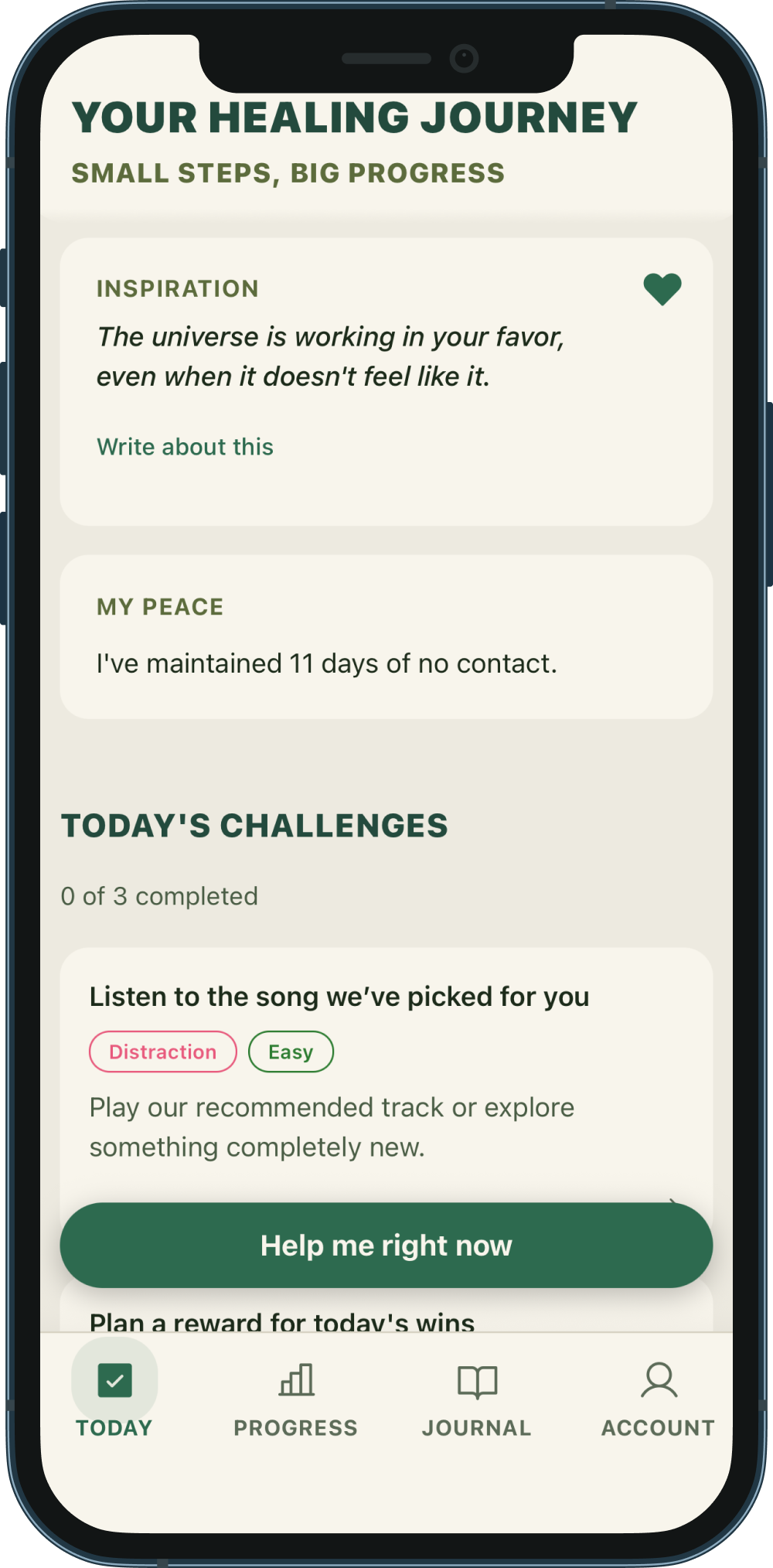
Free support for the week ahead
- Completely free
- Three challenges a day
- At your own pace
Circles Are Not the Same as Stuck
You might feel like you are going in circles. Look closer. Are the circles getting slightly smaller? Are the hard days a little less total? Do you come back to yourself a little faster?
That is often what healing looks like when it is working. It does not announce itself with a clean before and after. It shows up as a bad Tuesday that does not ruin the whole month, or a song that hurts but does not flatten you for a week.
You are allowed to be frustrated and still be moving. The wave that knocked you down yesterday does not erase the ground you already covered.
Stroebe, M. & Schut, H. (1999). The dual process model of coping with bereavement: Rationale and description. Death Studies, 23(3), 197-224. / Babyak, M., Blumenthal, J.A., Herman, S., Khatri, P., Doraiswamy, P.M., Moore, K., Craighead, W.E., Baldewicz, T.T., & Krishnan, K.R.R. (2000). Exercise treatment for major depression: Maintenance of therapeutic benefit at 10 months. Psychosomatic Medicine, 62(5), 633-638. / Bonanno, G.A. (2004). Loss, trauma, and human resilience: Have we underestimated the human capacity to thrive after extremely aversive events? American Psychologist, 59(1), 20-28.
Frequently Asked Questions
Why do I feel worse again after I was doing okay?
A song, a place, or a random memory can pull you back into the loss for a day or two. That is usually a trigger response, not proof that your progress disappeared. Most people heal in waves, not in a straight line.
How long does it take to heal from a breakup?
There is no fixed timeline. The more intertwined your lives were, the more recovery often asks of you. If hard days still come but the calm stretches between them slowly grow, that is often forward motion, even when it does not feel like it.
Am I going backwards if I still miss my ex?
Missing someone can coexist with healing. Going backwards usually means a trigger knocked you flat for a while, not that you still think about them sometimes. The overall trend over weeks matters more than any single day.