
How Long Should No Contact Last? What Research and Experience Show
No contact does not come with a fixed length that works for everyone. Readiness, real distance, and what you do with the space matter more than any number on a counter.

Key takeaways
- There is no magic number for how long no contact should last.
- Thirty days is common because it feels achievable, not because research picked it.
- Week one is usually the hardest. Many people see some relief by weeks two and three.
- Real no contact includes cutting indirect routes like social media checks.
- Ready to end it means a neutral conversation would not wreck your day.
You probably want a number. If you knew the exact day, you could white-knuckle your way there and then be done. You are mid-process and tired, and a target would make the uncertainty feel manageable.
No contact is less like a detox with a set end date and more like building a new default: less contact, less checking, less organizing your week around their moves. A number can orient you, but it will not tell you when you are ready.
Why 30 Days Is Everywhere
You will see 30, 60, and 90 days online, plus plenty of other targets. Thirty stuck partly because a month feels like a real unit: long enough to count as a stretch, short enough that you can picture reaching it.
Habit research offers a loose comparison, not a rule for breakups. In a real-world study of new daily habits, Lally and colleagues (2010) found that automaticity built on an uneven curve, with a median of about 66 days to reach 95% of each person’s plateau. Individual timelines ranged from 18 to 254 days. That study tracked eating, drinking, and activity habits, not breakup recovery. The parallel is loose, but change often takes longer than a month and looks different person to person. Thirty days is a worthwhile target, not a promise you will feel ready when it ends.
People also ask about one week. A week can be long enough to get through the worst urges and see whether distance helps you sleep or think a little more clearly. It is rarely long enough to mean the work is finished, especially after a longer relationship. Treat a week as a start, not a verdict on whether no contact works for you.
What Tends to Happen Over Time
What follows is what many people report, not a research-backed schedule. Treat it as a rough map; your timeline will not match it exactly.
Week one. Acute symptoms for most people: poor sleep, intrusive thoughts, a strong pull to reach out. If this is where you are, you are in the hardest stretch, not the permanent one. Research on how couples manage emotion together (Sbarra & Hazan, 2008) helps explain why the first days without contact can feel so physical when you have relied on someone for calm for a long time.
Weeks two and three. Some stabilization often starts here. The constant alertness may ease a little. You might get your first few hours of genuine okay-ness, then lose them again. Both belong to the same process. A bad night in week three does not mean week one never happened.
Month two and beyond. For many people, the slower work of sorting through what happened starts once the acute phase softens. The grief of what you lost can become easier to feel and harder to avoid, which can sound worse even when it means you have moved out of emergency mode. You may think more clearly about what the relationship was, not only what you miss.
Some people feel mostly better by week four. Others are still raw at week eight. Longer relationships, blurrier endings, and less support tend to stretch the timeline. None of that means you are doing it wrong.

What Matters More Than the Number
Whether you are actually out of contact. That includes the indirect routes: their social media, asking mutual friends for updates, rereading old threads. A clean count of days means little if you are still checking every night.
Whether you use the space for something. No contact works better with a little structure behind it: regular sleep, one or two people you can call, reflection that is not only replaying the relationship. Thirty days while you check their profile every night is still contact in the ways that count.
Whether the number matches your goal. If you want healing, the question is whether you feel steadier and less reactive, not whether the counter hit 30. If you want reconciliation, no contact may still help you show up more clearly later, but no specific length makes that outcome likely.
Whether you feel ready, not just done waiting. Ready means you could have a brief, neutral conversation without it wrecking your day: not because you are over them, but because their reply or silence would not set the whole week on fire. If you are counting mainly to win them back or prove something, the calendar is not the marker that matters yet.
Breakup Reset
Free support for the week ahead
- Completely free
- Three challenges a day
- At your own pace
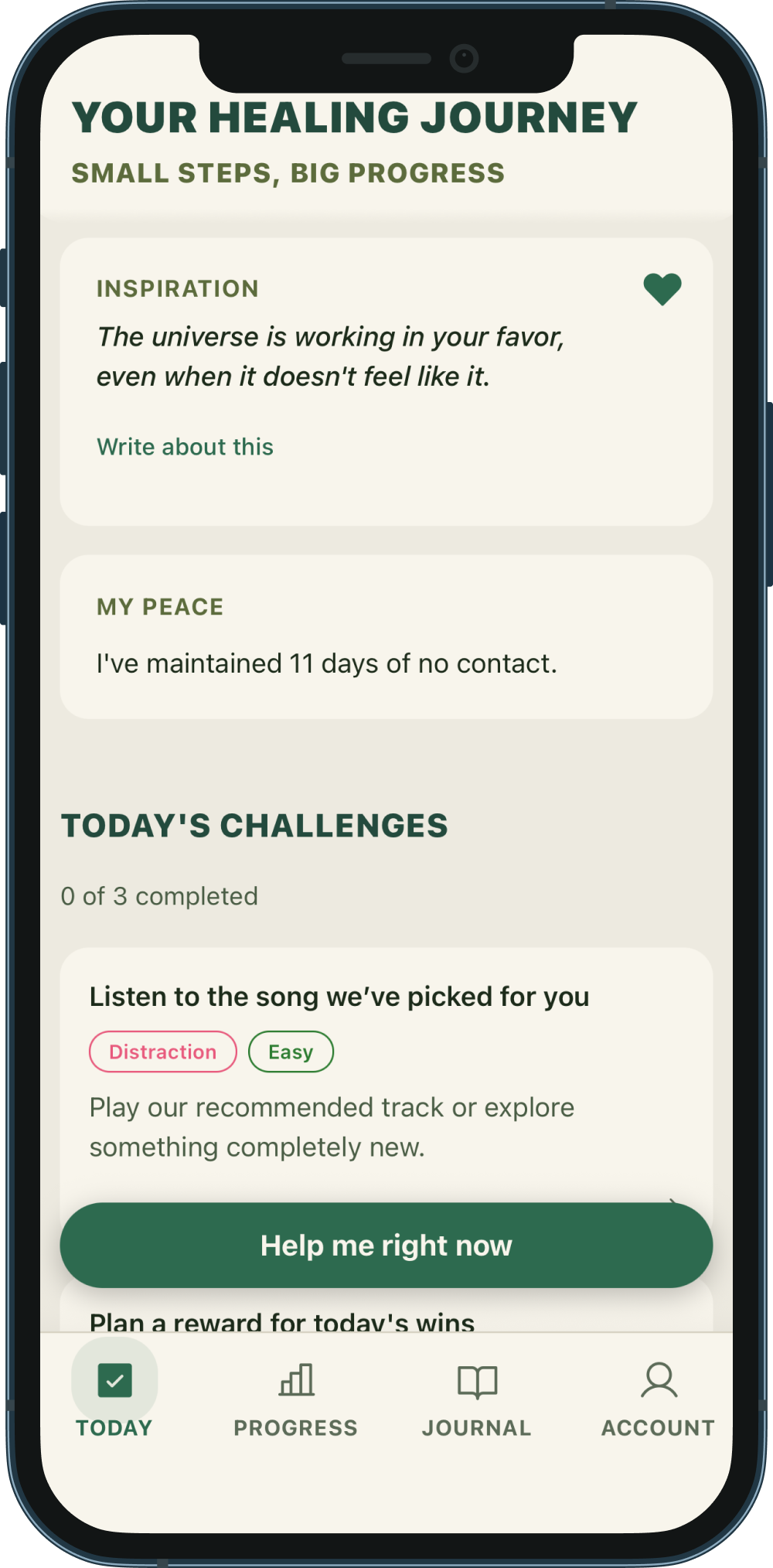
Breakup Reset uses 7, 14, 30, and 60-day markers as gentle checkpoints, not rules. Mark them if that helps; skip counting if it does not.
There Is No Finish-Line Day
You will not wake up one morning suddenly healed. You will have days with more sleep, fewer checks, and longer stretches without the urge to reach out. Keep going and you tend to get more of those days.
For why distance helps in the first place, see no contact after a breakup. For what to do when the urge hits hard, see keeping no contact when it feels impossible.
Lally, P., van Jaarsveld, C.H.M., Potts, H.W.W., & Wardle, J. (2010). How are habits formed? Modelling habit formation in the real world. European Journal of Social Psychology, 40(6), 998-1009. / Sbarra, D.A. & Hazan, C. (2008). Coregulation, dysregulation, self-regulation: An integrative analysis and empirical agenda for understanding adult attachment, separation, loss, and recovery. Perspectives on Psychological Science, 3(2), 141-167.
Frequently Asked Questions
Is 30 days of no contact enough?
Thirty days is enough for some people and nowhere near enough for others. It is a common target because it feels achievable and long enough to notice a shift, but no research backs it as the right length for everyone.
How long until no contact gets easier?
Many people find the first week the hardest, with some relief often showing up around weeks two and three. Sorting through what happened can take longer, and your timeline will not match a chart exactly.
When should you end no contact?
When you could have a brief, neutral exchange without it wrecking your day, and when you are doing it from steadiness rather than craving. Hitting a number on a calendar is not enough on its own.