
Grieving a Breakup You Chose: Why Ending It Does Not Stop the Hurting
Feeling sad after a breakup you initiated is normal and almost nobody talks about it. Here is why the grief comes anyway, and what to do with it.

Key takeaways
- The person who ends a relationship still loses the same things: the relationship, the future, the person, and who they were in it.
- Attachment does not dissolve at the moment of decision. It reorganizes the same way regardless of who said the words.
- Guilt (I did something wrong) and grief (something real was lost) can coexist; both are valid.
- The “did I make a mistake” loop is usually the nervous system running threat scenarios, not a clear-eyed evaluation.
- Writing down why you made the choice gives the loop something steadier to look at than the craving.
Most breakup content is written for the person who was left. The person blindsided. The person waiting for a text that never came. There is a whole genre of advice for that experience, and almost none for the person who did the leaving.
But the person who ended it often grieves too. And they often do so without permission, without much cultural acknowledgment, and without advice that fits their situation.
You made the decision. And it still hurts. Both things are real.
Why Ending It Does Not Stop the Loss
You grieve the relationship, not just the loss of them. You grieve the version of the future you thought you might have. You grieve the person you were in that relationship: the one who cooked with them, traveled with them, built habits with them. You grieve the ordinary things: the particular quality of a Tuesday evening that no longer exists.
These losses do not disappear because the ending was yours.
Attachment theory is clear on this: the attachment system responds to loss regardless of who initiated it. Sbarra (2006) found that emotional recovery after relationship dissolution followed similar patterns whether or not the person had initiated the breakup. The attachment was real; its reorganization is the same process for everyone.
What changes when you were the one who chose is the framing you are allowed. The person who was left has social permission to grieve loudly and visibly. The person who ended it often does not. There can be an implicit expectation, from others, and sometimes from yourself, that having made the decision means you accepted the loss already, that the grief should have been done before you pulled the trigger. It rarely works that way.
The Guilt Layer
Grief is not the only thing you may be carrying. You may also feel guilty. That is a different kind of pain, not the same as grief, though both can run at once.
Guilt says: I caused this. I caused their pain. I made someone suffer who I cared about. That is a real thing to sit with. You did make a choice that hurt someone.
But guilt and grief are not the same thing. Grief says: something real was lost. Guilt is about what you did. Grief is about what is gone. Both can coexist without either canceling the other, and both are worth naming separately so they do not collapse into each other.
Distinguish between them: if you are carrying guilt, the question is whether you acted with as much care and honesty as you could. If you did, the guilt is carrying more weight than it deserves. If there are things you handled badly, acknowledging them, to yourself, possibly to the person, is different from taking the full weight of their pain as yours to own.
The grief, meanwhile, is valid regardless of whether ending it was the right call.
The “Did I Make a Mistake” Loop
This loop is very common and almost never as reliable as it feels.
The mind in a grieving, stressed state runs alternative scenarios. What if I had stayed. What if I had done it differently. What if the thing I was ending it over was actually workable. The scenarios feel increasingly plausible at low moments, late at night, when something triggers a memory, when you see their name somewhere.
What is happening is not a clear-eyed reappraisal. The mind is looking for an exit from discomfort. It is running scenarios, not evaluating evidence. Missing them is a response to absence, not a signal that the decision was wrong.
Missing someone you loved and knowing you made the right choice can coexist completely. The feeling is not evidence about the decision.
What can help in these moments: write down the reasons you made the choice. Not to convince yourself, not a debate brief. A record. What you knew, what you had tried, what you could see that made continuing untenable or wrong. The reasons were real when you made the decision. They are still real. Giving the loop something steadier to look at than the craving interrupts it more effectively than arguing with the feeling directly.

Self-Trust after a Hard Decision
Making a difficult decision and then suffering for it does not mean the decision was wrong. It means it mattered. The loss is real. The pain is real. Neither of those things is evidence of error.
Self-trust after a hard decision is not the absence of doubt. It is acting in line with what you knew and holding that through the discomfort that follows. Doubt is not the same as being wrong.
Write: what you knew, and why you made the choice you made. Not as a defense, not for them, not to show anyone. For yourself. A stable account of what happened from the inside.
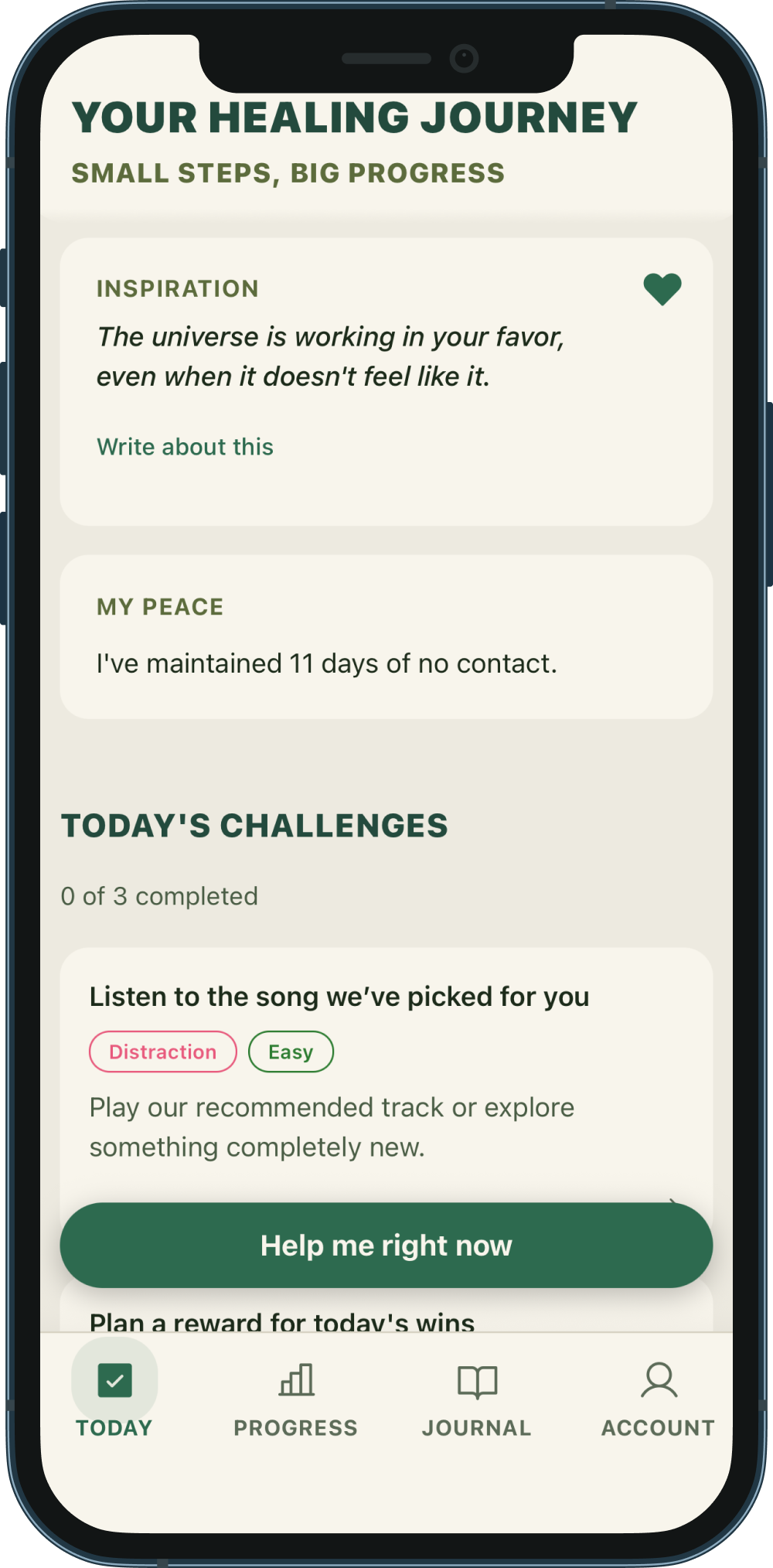
In Breakup Reset, the rebuilding and discovery challenges are most relevant for people who ended the relationship. The rebuilding challenges provide small daily activation when motivation is low. The discovery prompts address what the relationship taught you and what you know about yourself now, including the self-trust work of understanding what you stood for in making a hard call.
Breakup Reset
Free support for the week ahead
- Completely free
- Three challenges a day
- At your own pace
No Contact When You Were the One Who Ended It
No contact still matters here, but the framing is different.
When you were left, no contact is often about protecting yourself from someone who hurt you, keeping distance so the attachment can begin to reorganize. When you were the one who ended it, no contact is about something else: giving both of you space to reorganize without reopening the loop.
Reaching out because you feel guilty typically does not help the other person. It provides temporary relief for your guilt, which is about you, while reactivating their attachment system. Reaching out to soothe your own grief is the same pattern: it briefly alleviates the ache, then restarts the craving for both of you.
This is not a rule about forever. It is a recognition of what contact during the acute phase usually does.
For more on the mechanics, no contact after a breakup covers the reasoning in detail.
You Are Allowed to Grieve What You Chose to Leave
Choosing to end something that was not right does not mean the loss is not real. It does not mean you should feel fine. It does not mean you owe anyone a performance of certainty or relief.
You made a hard decision. You are grieving the loss it created. Both things can be true at once, without the grief meaning the decision was wrong, and without the decision meaning the grief is inappropriate.
The loss is real. You are allowed to feel it.
If the first week still feels like chaos, start with what to do after a breakup. If you still love them and the ending was right, getting over someone you still love speaks to that ache.
Slotter, E.B., Gardner, W.L. & Finkel, E.J. (2010). Who am I without you? The influence of romantic breakup on the self-concept. Personality and Social Psychology Bulletin, 36(2), 147–160. / Bonanno, G.A. (2004). Loss, trauma, and human resilience. American Psychologist, 59(1), 20–28. / Sbarra, D.A. (2006). Predicting the onset of emotional recovery following nonmarital relationship dissolution: Survival analyses of sadness and anger. Personality and Social Psychology Bulletin, 32(3), 298–312.
Frequently Asked Questions
Is it normal to miss someone you broke up with?
Yes, and it is much more common than people say. The person who ends a relationship loses the same things the other person loses: the relationship, the shared future, the company, the version of themselves that existed in that partnership. Attachment does not dissolve because you were the one who said the words. Grief follows loss, and ending the relationship is still a loss.
How do I know if missing them means I made a mistake?
Almost certainly not in the way the feeling implies. The mind in a stressed, grieving state runs alternative scenarios, what if I had stayed, what if I had done it differently, as a threat-response, not as a clear-eyed evaluation. Missing them is the attachment system responding to loss. It is not a signal that the decision was wrong. Write down the reasons you made the choice. Not to convince yourself, but to give the loop something steadier to look at than the craving.
Do I need to do no contact if I was the one who ended it?
Often, yes, but for different reasons. No contact when you ended the relationship is not primarily about protecting yourself from someone who hurt you. It is about giving both of you space to reorganize. Reaching out out of guilt, or to soothe your own grief, usually makes things harder for both people. It reactivates the attachment without resolving it, and can send confusing signals. Creating real distance still matters.