
Emotional Shutdown after a Breakup: When You Feel Nothing and Wonder If Something Is Wrong
Feeling flat, detached, or low on motivation after a breakup is a real grief response, not a sign you did not care. Here is what is happening and what gentle progress looks like.

Key takeaways
- Emotional shutdown is one end of a normal stress response range, not a character flaw or sign of not caring.
- Some nervous systems go quiet under overwhelming input rather than flooding; this is protection, not avoidance.
- Low motivation is not laziness. It is a depleted state where action genuinely feels harder than it is.
- Behavioral activation: the action has to come before the motivation, not the other way around.
- The bar for progress is deliberately low: one small thing counts, even when it does not feel like it.
Everyone expected this to be devastating. You agree that it matters. You know it ended. But mostly you feel flat. Not sad, not particularly anything. Like you are moving through your days behind a pane of glass, present, going through the motions, but not quite in contact with what is happening.
The tears might not be coming. Or they came once, briefly, and then stopped. You might even feel slightly guilty about how little you feel, as if you owed the relationship more drama than this.
Other people ask how you are doing and you say you are fine and wonder if you are right.
The Shutdown Response
When there is more coming in than the system can process at once, some nervous systems do not flood. They go quiet. This is one end of a range of normal stress responses.
One way to describe it, drawing on polyvagal theory (Porges, 2011): when neither fight nor flight is viable, the nervous system can move into a low-activation, quiet state instead. It goes still rather than loud. It is not the only model, but the pattern it describes is real, going inward and flat as a response to overwhelm, not as a choice.
This is not emotional avoidance. It is one way the nervous system absorbs what it cannot process immediately.
It also does not mean the relationship did not matter. The flatness and the caring are not in conflict. They can coexist.
Brief shutdown after a significant loss is common and does not require diagnosis. If the flatness extends to everything for several weeks and you cannot function in daily life, that is worth talking to someone about. The early phase is typical. Prolonged, spreading flatness is a different thing.

Why the Feelings Often Arrive Later
For people in this pattern, the acute emotional response is often deferred. The relationship ends; the immediate period is flat or functional; and then, weeks or months later, the grief arrives. It can show up in unlikely moments: an ordinary day, a trigger that seems small, something that strips away the busyness.
This is not regression. Bonanno (2004) describes varied grief trajectories in which the timing and shape of emotional responses differ significantly between individuals, and deferred responses are well within the documented range of normal. The emotion was there. It was waiting for conditions in which it could arrive.
If you are currently in the flat phase, this is worth knowing: the feelings not being here yet does not mean they are not coming, or that you are doing grief wrong. They will have their own timing.
The Low-Motivation Trap
Nothing appeals. Getting started on anything, even something you would normally enjoy, takes enormous effort. The things that would help (moving, connecting, writing) feel pointless before you start them. You cannot generate a reason to do the thing that would generate a reason.
This is the specific difficulty of the shutdown pattern. Motivation is one of the first things affected by emotional depletion. Waiting for motivation to return before acting is waiting for something that only returns through acting.
Martell, Addis and Jacobson (2001) describe the principle: action comes before mood improvement, not after it. Small actions slightly improve state. That improved state makes the next small action marginally easier. The loop starts with the action, not the feeling. One thing, enough to count.
What Gentle Activation Looks Like
The bar is deliberately low because the weight is genuinely high.
One physical thing. A short walk. A meal you actually cook. A shower. These are not self-care rituals. They are biological floor maintenance, and they count as progress even when they do not feel like it.
One concrete task. Dishes. One email. Clearing one surface. Completing something, anything, starts to shift the loop slightly. Not because it is meaningful, because the nervous system registers completion and uses it.
One small connection. A text to one person. You do not have to explain how you are doing. “I’m a bit flat lately” is enough. Staying loosely connected prevents isolation from compounding the shutdown.
One change to your environment. A different route. A cleared surface. Not a transformation: a small disruption to sameness, which is one of the conditions that keeps the low-activation state running.
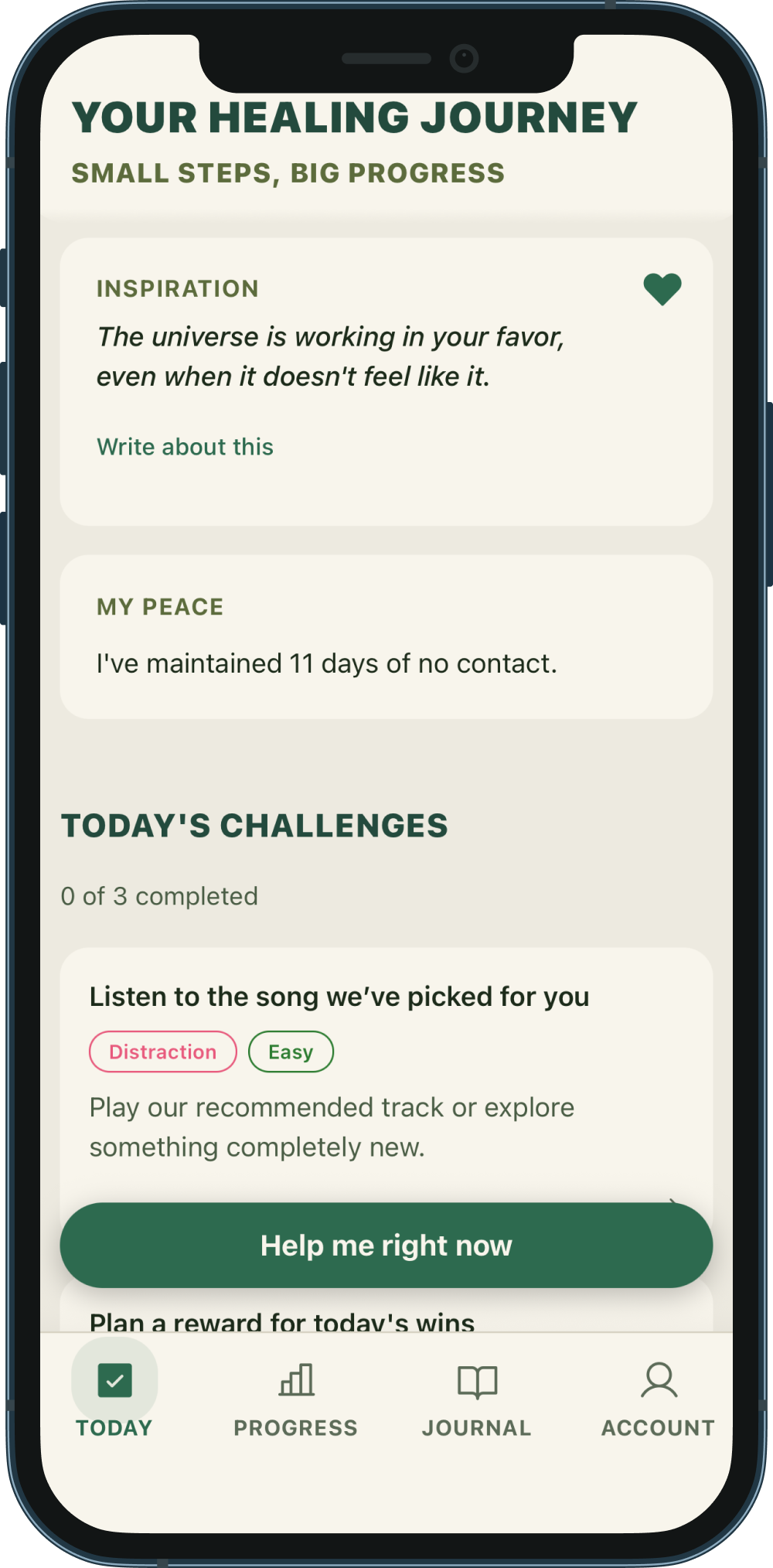
Breakup Reset’s Reset Builder track is built for exactly this. The rebuilding challenges provide the smallest possible activation loop: a walk, a cleared surface, one concrete step. The self-care challenges hold the floor while the rebuilding ones slowly widen it. Neither asks you to feel better first. Both ask for one small thing. That is the whole design.
Breakup Reset
Free support for the week ahead
- Completely free
- Three challenges a day
- At your own pace
Flat Is Not Fine. It Is Also Not Broken.
Low activation after significant loss is real. It is one way the mind absorbs more than it can feel all at once. It is not a sign you did not love them, or that the relationship did not matter, or that you are less capable of grief than other people.
The motivation will return, but probably not on a schedule you can predict from here. The feelings will surface when they have space. Until then, small steps still build something, even when you cannot feel them building.
If the flatness has been present for several weeks and is affecting your ability to manage daily life, it is worth getting support. Grief and clinical depression overlap, and both deserve care. You do not have to be in crisis for that to be the right call.
For more on the early flat period specifically, the first week or two when everything just goes quiet, feeling numb after a breakup covers that phase and what usually helps.
Porges, S.W. (2011). The Polyvagal Theory: Neurophysiological foundations of emotions, attachment, communication, and self-regulation. W.W. Norton. (presented as one model; note that elements of the polyvagal model remain debated in research literature.) / Bonanno, G.A. (2004). Loss, trauma, and human resilience. American Psychologist, 59(1), 20–28. / Martell, C.R., Addis, M.E. & Jacobson, N.S. (2001). Depression in Context: Strategies for Guided Action. W.W. Norton. (behavioral activation principle; developed in depression context, applied here by extension.)
Frequently Asked Questions
Why do I feel flat and unmotivated after my breakup instead of sad?
Some nervous systems respond to overwhelm by going quiet rather than loud. When there is more to process than the system can absorb at once, low activation can follow: a kind of internal pause rather than collapse. This is a real grief response. It does not mean you did not care. For many people, the more intense emotions arrive later, when the system has had time to start processing.
What is behavioral activation and how does it help after a breakup?
Behavioral activation is a principle from clinical psychology: small actions tend to slightly improve emotional state, and that improved state makes the next action a little easier. The key is acting before motivation arrives, not waiting for motivation first. After a breakup, motivation is often one of the first things to disappear. The activation loop has to start with the action, a short walk, one task completed, even when nothing feels worth doing.
When should I be concerned that my emotional shutdown is something more serious?
If the flatness persists for more than a few weeks, includes loss of interest in things you normally care about across most areas of your life, and affects your ability to function in daily tasks, it is worth talking to a doctor or therapist. Emotional shutdown after a breakup is common. Extended flatness that does not lift and spreads into everything is a different pattern and deserves support.