
Emotional Overwhelm after a Breakup: When the Grief Comes in Waves You Can't Predict
Mood swings, intense nights, and moments you cannot explain are common in breakup grief. Here is what drives the overwhelm and what steadies it.

Key takeaways
- Emotional swings are driven by a nervous system responding to loss, not instability on your part.
- Evenings are harder because daytime activity masks the activation; when stimulation drops, the attachment system surfaces.
- Oscillating between okay and not okay is the research-supported norm, not a sign you are getting worse.
- Physical grounding, breathing, movement, location change, works faster than thinking your way through a wave.
- Planning the evening in advance is more effective than willpower when a spike hits.
It is late. The day was fine. You worked, you moved through it, you even had a stretch where you were not thinking about it. And then something small happened. A song. A notification from the wrong person. Nothing at all. And suddenly it is all the way wrong again. You are furious, then hollow, then numb, then something close to okay, then back.
You did not see it coming. You cannot find the logic in it. It does not match the version of grief where you feel bad for a while and slowly get better.
Why the Swings Happen
A significant loss puts the nervous system in an elevated state that is not its normal baseline. The threat response, the same system that activates in response to physical danger, gets engaged by major emotional loss. When you are in that state, your capacity to absorb ordinary small things is reduced. A notification, a song, a smell can register with the force of something much larger because the system processing it is already running close to capacity.
Fisher et al. (2010), studying brain activity in people rejected in love, found that romantic rejection activates the same reward and craving circuitry involved in other forms of craving and withdrawal. The emotional activation after a breakup is partly the same mechanism. When that circuitry is running, calm takes effort and spikes take very little.
There is also the co-regulation loss. Sbarra and Hazan (2008) describe how close relationships become physiologically regulatory: the other person’s presence, voice, and predictability help stabilize your arousal levels. When that person is gone, you are regulating on your own again, which takes more effort, especially early on.
The Day-Night Pattern
This is one of the most consistent features of breakup grief and one of the least-discussed.
During the day there is structure. Work, tasks, people, movement, these occupy enough of your attention that the loss is not the loudest thing in the room. Not suppression, just displacement.
In the evening, that falls away. Stimulation drops. There is nothing to attend to. The urge to reach out peaks. The replaying starts. Things that felt manageable at noon feel catastrophic at midnight.
Almost nobody warns you about this specifically. It is not you being dramatic. It is a feature of grief that most people going through a significant loss experience, and knowing it is coming does not make it easy, but it changes how you interpret it when it arrives.

Why It Is Not a Sign Something Is Wrong
Oscillating between okay and not okay is the documented norm in grief, not a warning sign. Bonanno (2004), across multiple studies of loss and resilience, found that most people who recover well are not steadily improving. They move between distress and relative stability, often in ways that do not track with how long it has been or how much they expected to feel.
The moments of being okay are real. They are not denial or avoidance. They are the nervous system taking brief recoveries between harder stretches. The crashes after them are not setbacks. They are the rhythm.
What is worth taking note of: if intense difficulty eating, sleeping, or functioning has been persistent for more than a few weeks without any lighter stretches at all, that is worth talking to someone about. The normal pattern includes genuine moments of feeling okay. A relentless flat inability to function is a different thing.
What Grounding Does When a Wave Hits
In the middle of a spike, reasoning does not work well. Trying to think your way through a wave, arguing with the feeling, analyzing it, deciding it is irrational, typically prolongs it. Physical responses work faster.
Breathe first. The 4-1-5 technique: four seconds in, one second hold, five seconds out. The extended exhale activates the parasympathetic nervous system (the calming part) faster than anything you can do with your thoughts. Three to five rounds is enough to take the edge off the spike. Do this before deciding anything.
Change something physical. Stand up. Move to a different room. Go outside for two minutes. The pattern interrupt does not need to be large. Changing your physical situation is enough to slightly shift what the nervous system is registering.
Move your body. Walking, stretching, a body scan lying down. The wave is partly held in the body, not only in the mind. Physical movement gives the activation somewhere to go.
Write one thing down. Not to solve it. Not a full journal entry. One sentence naming what is happening. Getting a thought out of active rotation by putting it on a page is enough to reduce its urgency slightly. Then close it.
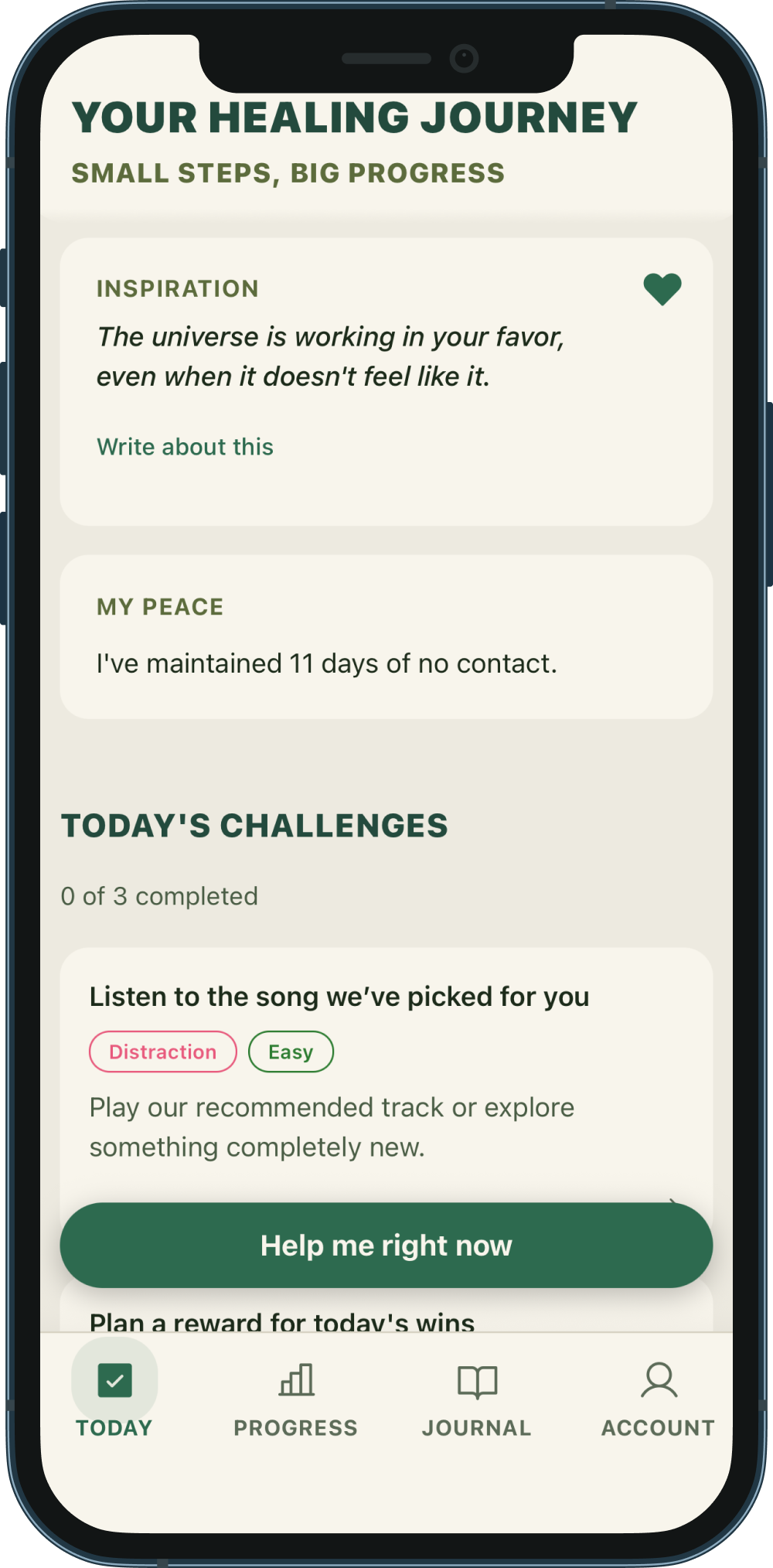
When a wave hits, Breakup Reset’s support hub, “Help me right now”, has breathing, a quick journal moment, and distraction options. If you recognize the Storm Rider pattern, the distraction challenges will be particularly useful between waves: something concrete to do that has nothing to do with your ex. Self-care challenges help anchor the evenings.
Breakup Reset
Free support for the week ahead
- Completely free
- Three challenges a day
- At your own pace
Structure Is Not Control
Having a plan for the evening is not the same as forcing yourself to feel better or suppressing what is there.
Structure works because it provides predictability. The nervous system in a stressed state has a lower baseline capacity and uses more of it managing uncertainty. Knowing roughly what the next hour holds, a walk, dinner, a show to finish, a call at a specific time, takes a small amount of that load off. Not all of it. Just enough to make the drop into unstructured time less steep.
One anchoring plan for the evening. One small thing to return to. Not a full schedule. The bar is low because the load is already high.
In Breakup Reset, this is the Storm Rider type, built specifically for people whose grief comes in waves and who benefit from structure, grounding, and something concrete to do when the spike hits. The distraction challenges provide short, practical actions. Self-care challenges give the evening something to anchor to.
The Waves Get Further Apart
The intensity is not permanent, even when it feels like it is. The oscillation between okay and not okay is real, but over time, the okay stretches tend to get longer and the crashes tend to get shorter. Not in a straight line, and not on a predictable schedule. But the rhythm does shift.
The work is not to eliminate the waves. It is to get through them without the decisions you will regret. To not send the message at midnight. To not make the call at 2am. To arrive at the next morning having done nothing that makes the next week harder.
That is enough for now.
If you want a steadier first-week plan, see what to do after a breakup. For nights specifically, try breakup anxiety at night. If you can barely function, start with when you cannot function after a breakup.
Fisher, H.E., Brown, L.L., Aron, A., Strong, G. & Mashek, D. (2010). Reward, addiction, and emotion regulation systems associated with rejection in love. Journal of Neurophysiology, 104(1), 51–60. / Bonanno, G.A. (2004). Loss, trauma, and human resilience. American Psychologist, 59(1), 20–28. / Sbarra, D.A. & Hazan, C. (2008). Coregulation, dysregulation, self-regulation: An integrative analysis and empirical agenda for understanding adult attachment, separation, loss, and recovery. Perspectives on Psychological Science, 3(2), 141–167.
Frequently Asked Questions
Why are evenings and nights so much harder after a breakup?
During the day there is activity and structure to fill the space. In the evening, stimulation drops and there is nothing to redirect attention with. The attachment system, quieter when you are busy, activates. The urge to reach out typically peaks at night for exactly this reason. Having something anchoring the evening matters more than willpower once the drop happens.
Is it normal to feel fine one hour and completely devastated the next?
Yes. Oscillating between okay and not okay is the documented norm in grief research, not a sign of regression or instability. The nervous system is not in its baseline state after a significant loss, so small things register as large. A moment that would normally be manageable can feel catastrophic when you are already depleted.
What is the 4-1-5 breathing technique?
Breathe in for four seconds, hold for one second, breathe out for five seconds. The extended exhale activates the parasympathetic nervous system, the part responsible for calming, which is why extended out-breaths have a measurable effect on heart rate and arousal. The ratio matters more than the exact count: inhale shorter than exhale. You can do three to five rounds in under two minutes.